
Why Pretending You Know Nothing Might Save Your Progress
The Most Useful Thing I Ever Did Was Pretend I Knew Nothing
The biggest obstacle to progress isn't lack of knowledge. It's believing you already have enough.
By Norm Rieger | The New Norm
There is a particular kind of stuck that only experienced men get into. Not beginners. Not the guy who just walked into a gym for the first time, nervous and unsure where anything is. That guy is actually in a pretty good position because he knows he doesn’t know anything and so he’s open to learning. The dangerous stuck belongs to the man who has been around long enough to have opinions. The man who has tried things, read things, heard things, and accumulated enough experience that he walks into any new approach with a head already full of what he thinks he knows.
I was that man for a long time. And being that man cost me years of results I could have had sooner.
“I was tired of being right about things that weren’t working.”
Here’s the honest version of my history before the contest that changed everything. I’d been lifting on and off for years. I understood, at least conceptually, how muscles worked. I’d tried multiple diets. I’d read articles. I’d watched videos. I had done enough that I felt like I had a working knowledge of what was required. And that working knowledge was exactly the problem. Because if my working knowledge was actually sufficient, I would have already looked the way I wanted to look. I didn’t. Which meant something I believed about what I was doing was wrong. But because I thought I knew enough, I kept doing variations of the same things and expecting different results. You know the definition of that.
The Decision That Changed Everything
Then at 53 years old I saw a local New York City trainer named Maik Weidenbach, a former Olympic swimmer and Wall Street dropout turned gym owner, running a physique transformation contest on Instagram. Best improved physique wins ten thousand dollars and a professional photoshoot. No age limit. I signed up. And here is the decision that made the difference, a decision so simple it almost sounds like nothing until you actually try to do it.
I decided to pretend I knew absolutely nothing.
The Entire Article in One Sentence
If I already knew how to get the result I wanted, I would already have the result.
Not as a performance. Not as false humility. As a genuine strategic choice made by a man who was tired of being right about things that weren’t working. If I already knew how to get lean and defined and muscular, I reasoned, then I would already be lean and defined and muscular. I wasn’t. Therefore, whatever I thought I knew was either incomplete, incorrect, or being applied wrong. So I was going to set all of it aside and follow the program exactly as written, without modification, without editorial, without the quiet internal commentary of a man who thinks he’s been around long enough to know better.
Maik gave me exercises that seemed, at the time, a little ridiculous to me. I did them anyway. Not grudgingly. Without judgment, because I had decided in advance that my judgment on this subject had already been disqualified by my own results. He prescribed rep ranges and rest periods and a nutritional structure that was more detailed and more demanding than anything I’d tried before. I followed it. He wanted me to weigh and measure and track every single thing I consumed for four months. I did it. Every meal. Every day. Without exception and without complaint, because I had committed to the program and I had already decided I didn’t know enough to override any part of it.
That last piece, the tracking, is where most men with experience quit. Not because it’s hard to understand. Because it’s inconvenient, and because men who think they have a general sense of what they’re eating convince themselves that general is good enough. It isn’t. General is the gap between effort and results for most men in this demographic. I know because general was my approach for years, and general efforts produced general results. The program required precision. I gave it precision.
“General efforts produced general results.”
Four months later I was at roughly eight percent body fat. I won the contest. I pocketed ten thousand dollars. And I had something more valuable than either of those things. I had a complete, functional understanding of how my body actually responded to training and nutrition when both were applied correctly and consistently over a sustained period of time. Not a theory. Not a concept. Proof, generated by my own body, that I could now use for the rest of my life.
What Is Beginner's Mind?
The beginner’s mind, which is a concept with roots in Zen philosophy that I didn’t know much about at the time and arrived at practically rather than intellectually, is simply the willingness to approach something you think you already understand as if you’re encountering it for the first time. Without the filter of prior conclusions. Without the ego investment in your existing approach being the right one. With the genuine curiosity of someone who has not yet decided what the answer is.
It sounds easy. Yet it is genuinely difficult for men who have been competent at other things for decades. Because competence in one area creates a default assumption of competence in adjacent areas. A man who has built a business, raised kids, managed people, and navigated complexity for thirty years has strong pattern recognition and good instincts. Those are real assets in most contexts. In the gym, when those instincts have already been tested and found insufficient, they become obstacles wearing the costume of wisdom.
“Those instincts have already been tested and found insufficient.”
The willingness to set that down, to say out loud or at least to yourself that you are going to treat this as if you know nothing and follow someone else’s guidance exactly, is an act of genuine intellectual courage for a man who has been capable and competent for most of his adult life. It feels like a demotion. It isn’t. It’s a promotion to the level of someone who is actually going to get results instead of someone who is going to continue being right about things that aren’t working.
“It feels like a demotion. It isn’t.”
This Is Not Blind Obedience
I want to make a distinction here that matters, because this is not an argument for blind obedience to any program or any person. It’s an argument for honest self-assessment before you start. The question isn’t whether you should follow a program. The question is whether the results you have produced so far (or past results not sustained) with your existing knowledge justify the confidence you bring to your next attempt. If the answer is no, and for most men reading this the honest answer is no, then the most productive thing you can do is set the existing knowledge aside, find someone who has produced the result you want and knows how to teach it, and follow their guidance without modification until you have your own evidence to work from.
After the contest, I had that evidence. Now when I train, when I structure nutrition, when I make decisions about phases and approaches and adjustments, I’m working from a foundation of things I have personally tested and proven rather than things I read about or partially applied. That’s a completely different position to operate from. And I couldn’t have gotten there without being willing to become a beginner first.
Unexpected Benefit
When you stop managing the program and simply execute it, you free up enormous mental energy that was previously spent second-guessing every decision.
There’s something else I want to say about the experience of following a program that precisely, because it surprised me and I think it will surprise you too if you do it. When you commit completely, without the mental energy going toward evaluating and second-guessing and modifying, something opens up. You’re no longer managing the program. You’re just doing it. And doing it turns out to be significantly more productive than managing it. The cognitive load of deciding whether you agree with each component, whether this exercise is really necessary, whether this rep range is optimal, whether you could substitute this meal for something more convenient, all of that disappears when you’ve made the decision in advance that you’re going to follow the program as written. What’s left is just execution. And execution, applied consistently over four months, produces results that years of managed effort never did.
“Doing it turns out to be significantly more productive than managing it.”
That was the lesson. Not that Maik’s program was magic. Not that I needed someone else to figure things out for me permanently. That I needed to build a foundation of real evidence before my opinions were worth trusting. And the only way to build that foundation was to set the opinions aside long enough to actually run the experiment correctly.
After the contest, I had that evidence. Now when I train, when I structure nutrition, when I make decisions about phases and approaches and adjustments, I’m working from a foundation of things I have personally tested and proven rather than things I read about or partially applied. That’s a completely different position to operate from. And I couldn’t have gotten there without being willing to become a beginner first.
One Honest Question
Am I willing to pretend I know nothing?
If you’ve been around the gym for years and you still don’t look the way you want to look, I’d ask you to sit with one honest question before your next attempt. Not what program should I try. Not what am I doing wrong. Just this: am I willing to pretend I know nothing?
Because that decision, made honestly and held completely, is worth more than any program you could pick.
It’s a practical decision made by a man who is tired of being right about things that aren’t working. And if that sentence lands for you the way it landed for me when I finally admitted it to myself, you might be closer to the result than you think.
Work With Norm
Norm Rieger is a men’s lifestyle coach, speaker, and author of The New Norm, a book about building the body and life you want by training the mind first.
If you’re ready to stop managing your approach and start executing one that actually works, book a one-on-one coaching consultation.

How to Lose Belly Fat After 50: The Honest Answer
How to Lose Belly Fat After 50
The Honest Answer Most Coaches Won’t Give You
By Norm Rieger | The New Norm
“The belly fat isn’t just sitting there. It’s participating.”
The Midsection Problem Almost Every Man Understands
You’re training. You’re trying to eat better. You’re doing “pretty good.” And yet the stomach barely moves. Sound familiar?
This post is for men in their 40s, 50s, and 60s who feel like their body stopped responding the way it used to. Because honestly? It did. And pretending otherwise helps nobody.
Belly Fat After 50 Is Biologically Different
This is the first thing most men need to understand. The belly fat men carry later in life is not simply:
- poor discipline
- laziness
- aging
- lack of cardio
It’s a hormonal and metabolic problem.
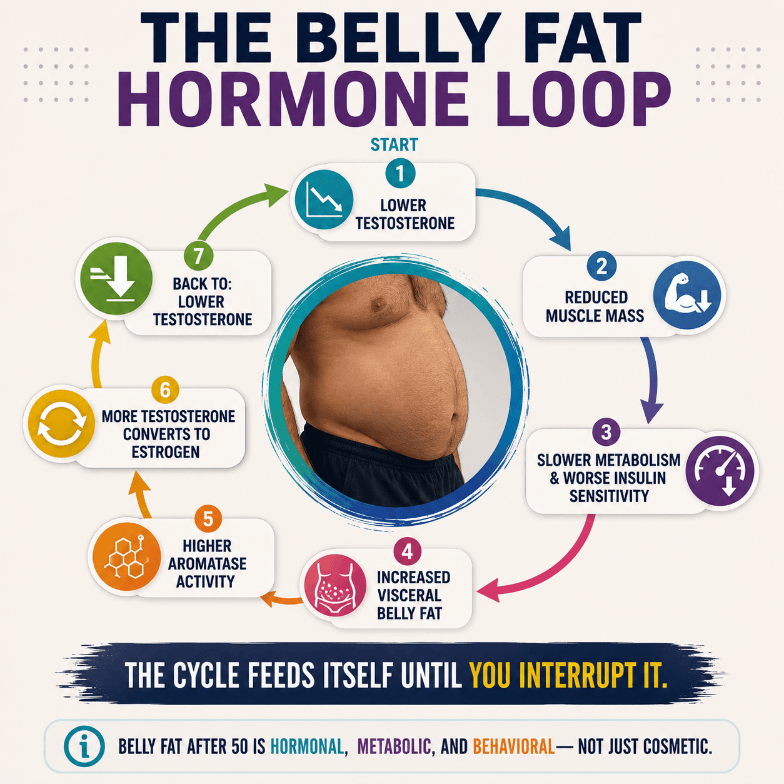
Specifically: visceral fat. The deeper abdominal fat surrounding the organs. And unlike the softer fat you carried in your 20s or 30s? Visceral fat is metabolically active.
Meaning: It actively influences hormones, inflammation, insulin sensitivity, and metabolism. It participates in the problem.
The Testosterone Loop Most Men Never Hear About
Testosterone production gradually declines beginning roughly around the mid-30s. Research estimates average declines of approximately 1–2% annually in many men. By the time men reach their 50s, they may have lost a meaningful percentage of peak production.
That matters because testosterone strongly influences:
- muscle retention
- insulin sensitivity
- energy expenditure
- recovery
- fat storage patterns
Lower testosterone often contributes to: Increased abdominal fat storage.
But then the cycle gets worse. Because visceral fat contains: Aromatase
An enzyme that converts testosterone into estrogen.
Meaning:
More belly fat → lower testosterone → more belly fat.
The cycle feeds itself.
Why Most Men Attack the Problem Backwards
This is the sequencing mistake almost every man makes. They decide to “get in shape” and immediately focus on:
- building muscle
- bulking
- eating more protein
- lifting heavier
…while still carrying a significant amount of body fat. And unfortunately? For most natural middle-aged men:
Trying to build significant muscle while aggressively losing fat usually fails.
At least simultaneously. Because your body needs:
- energy surplus to efficiently build tissue
- energy deficit to efficiently lose stored fat
Those are opposite biological signals.
“You can’t press the gas and brake hard at the same time and expect efficiency.”
The Statue Analogy
Here’s the simplest way I know how to explain this. Picture the body you want as a stone statue. Right now? The statue is wearing a jumpsuit. You can’t clearly see the shape underneath. Most men try to add muscle first.
So they start:
- eating more
- training harder
- chasing size
But all they’re really doing is stuffing more underneath the jumpsuit.
You can’t accurately tell:
- what’s muscle
- what’s fat
- whether the plan is truly working
The smarter sequence? Remove the jumpsuit first. Get lean enough to reveal the structure. Then when you begin building muscle, you can actually SEE the changes happening. That’s the sequence. Fat loss first. Then muscle.
The Weird Middle Phase Nobody Warns You About
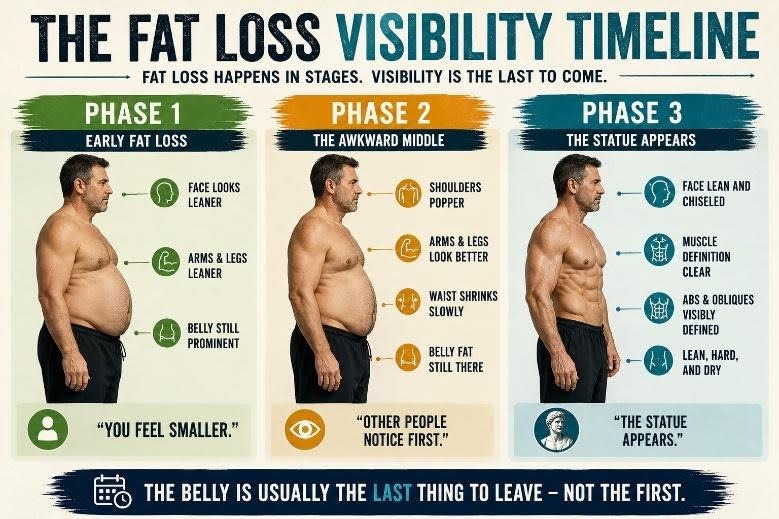
This part messes with people psychologically. When fat loss begins:
- your face leans out first
- your arms and legs lean out
Meanwhile:
The stomach hangs on like it’s protecting classified information.
That’s normal. Our bodies biology prioritizes abdominal fat storage aggressively. Especially visceral fat. There’s an awkward middle phase where men often think: “I’m just getting smaller.”
I experienced this personally. When I dieted down nearly 30 pounds in my mid-50s, I felt smaller. But suddenly other people started saying:
- “You look jacked.”
- “You look huge.”
- “What are you doing?”
Even though I weighed dramatically less. Because:
Lean changes everything.
The muscle was already there. It just became visible.
So What Actually Works?
No amount of:
- crunches
- ab circuits
- fat burners
- spot reduction gimmicks
…will specifically burn belly fat.
That concept has been disproven repeatedly in exercise physiology research. What DOES work is creating conditions where your body has no choice but to pull from stored fat over time.
That comes down to three things.
1. A Real Caloric Deficit
Not “eating clean.” Not “trying hard.” Not “mostly healthy.” A measurable deficit.
Fat loss always requires:
Calories out > calories in.
That’s the mechanism.
A sustainable deficit of roughly 300–500 calories daily is usually enough to steadily lose fat while preserving muscle. Most men dramatically underestimate intake. Especially:
- oils
- nuts
- restaurant meals
- alcohol
- weekend eating
Track honestly for a few weeks. Most people are shocked by what they discover!
2. High Protein Intake
When calories drop, your body can pull energy from:
- fat
- muscle
Protein helps preserve lean tissue.
For most active men over 50: roughly 0.75–1 gram per pound of target body weight is a highly effective range during fat loss.
Without adequate protein? The body often sacrifices muscle alongside fat.
And that usually worsens:
- metabolism
- appearance
- rebound potential
3. Resistance Training
This is the part most people still underestimate. Resistance training does far more than “burn calories.” It helps:
- preserve muscle
- improve insulin sensitivity
- support testosterone levels
- increase metabolic rate
- improve body composition
And importantly, it changes the hormonal environment. That’s why endless cardio alone usually disappoints middle-aged men.
You cannot outrun:
- poor nutrition
- hormonal dysfunction
- muscle loss
The training that changes middle-aged physiques most dramatically is progressive resistance training. Not living on a treadmill.
“The goal isn’t becoming lighter. The goal is becoming leaner.”
Final Thoughts
At 54, I looked better than I did at 34. Not because of perfect genetics or shortcuts.
Because I finally understood:
- the sequence
- the deficit
- the hormonal reality
- protein intake
- resistance training
- consistency
The belly fat that feels permanent usually isn’t permanent. But it does require:
Understanding the mechanism.
And doing the work in the right order. That order starts with fat loss. Then the muscle becomes visible. Then the entire body changes.
Research & Clinical References
Not gimmicks. Actual physiology and endocrinology.
- National Institutes of Health — Visceral fat and metabolic dysfunction
https://www.ncbi.nlm.nih.gov - Journal of Clinical Endocrinology & Metabolism — Testosterone decline and aging men
https://academic.oup.com/jcem - Frontiers in Endocrinology — Aromatase activity and obesity in men
https://www.frontiersin.org - American College of Sports Medicine — Resistance training and body composition
https://www.acsm.org - Obesity Reviews — Visceral fat reduction and metabolic health outcomes
https://onlinelibrary.wiley.com/journal/1467789x
About Norm Rieger
Norm Rieger is a men’s lifestyle coach, speaker, entrepreneur, and author of The New Norm — a project focused on helping men over 40 rebuild their health, physique, discipline, and mindset.
After transforming his own life later in adulthood, Norm now works with men looking for practical, honest guidance around fitness, body composition, nutrition, habits, recovery, and long-term health optimization.
“The body you want is usually buried under the habits you’re still negotiating with.”
Peptides: Cutting Through the Noise
Peptides: Cutting Through the Noise
By Norm Rieger | The New Norm
“The problem with peptide information isn’t ignorance. It’s incentives.”
Everybody’s Talking About Peptides. Most People Have No Idea What They’re Talking About.
This post is for people who’ve been hearing about peptides nonstop over the last few years and are trying to figure out what’s real, what’s hype, and what’s complete nonsense.
I’ve been using peptides for several years — long before they became trendy TikTok content. I’ve:
- tested products through US and international laboratories
- experimented with multiple compounds personally
- watched the gray market evolve in real time
- spent years separating legitimate science from marketing theater
And after all of that, I can give you the simplest honest summary possible:
Some peptides are incredibly promising. Some are massively overhyped. Some are genuinely useful. Some are basically expensive hope.
And the internet currently treats all of them like they belong in the same bucket. That’s the first mistake.
What Peptides Actually Are
Let’s start with the definition, because most confusion starts immediately. Peptides are chains of amino acids. That’s it. Not magic. Not steroids. Not some mysterious underground category of substances.
In fact, compounds people already know well — including insulin — technically qualify as peptides.
The important distinction is this: each peptide interacts with specific biological pathways for specific purposes.
That’s why the question:
“Should I go on peptides?”
…doesn’t really make sense.
That’s like asking: “Should I go on supplements?” Nobody says that.
They say:
- “I take Vitamin D because I’m deficient.”
- “I take creatine for strength and recovery.”
- “I take magnesium for sleep.”
Specific compound. Specific purpose. Specific goal.
Peptides need to be approached the exact same way.
My Experience With Peptides
I started experimenting with peptides years before they became mainstream. The compounds I’ve personally used include:
- BPC-157
- TB-500
- GHK-Cu
- C-Max
- SS-31
- DSIP
- Melanotan
- 5-Amino-1MQ
- SLUP-332
- MK-677
- Cardarine
- multiple GLP-class compounds
And before anyone assumes my transformation came from pharmaceuticals, let me make something clear.
I won my physique contest at 54 before I ever touched the GLP class.
That transformation came from:
- training
- nutrition
- consistency
- discipline
The peptide experimentation came afterward. That context matters.
“The peptides didn’t build the discipline. The discipline came first.”
Some Worked. Some Didn’t.
This is where I’m probably different from most people selling peptide content online. I’m perfectly willing to tell you when something didn’t impress me.
The GLP Class
The GLP class — including:
- Semaglutide
- Tirzepatide
- Retatrutide
…has produced the most obvious metabolic and weight-loss effects of anything I’ve personally experimented with.
Retatrutide in particular looks extremely promising.
Research continues to show effects extending beyond weight loss into:
- insulin sensitivity
- metabolic flexibility
- appetite regulation
- body composition improvement
The early data is significant enough that many researchers believe multi-agonist compounds like Retatrutide may become major players in obesity and metabolic disease treatment over the next decade.
At the same time, we are still early in understanding the full long-term picture. That matters too.
BPC-157: The One I’d Keep Around
If there’s one peptide I’d probably keep in my toolkit under most circumstances, it’s BPC-157.
I originally used it for tendon issues in my shoulder and elbow.
The results were encouraging, but healing is complicated and I couldn’t always isolate whether the peptide was truly responsible.
Then I snapped a tendon in my left forearm. I heard it snap. I dropped off the pull-up bar mid-set. I couldn’t carry my gym bag with my left hand.
I immediately started an aggressive BPC-157 protocol alongside TB-500.
Within three weeks:
- I was doing pull-ups again
- bench pressing heavy again
- functioning almost normally
That recovery timeline was difficult for me to dismiss as placebo or coincidence.
Now does that qualify as clinical proof? No. It qualifies as personal experience. And personal experience matters — as long as you’re honest about what it is and what it isn’t.
The Problem With Stacking Compounds
This is another thing people online rarely admit. Once you start stacking multiple compounds together, causation becomes extremely difficult to prove.
You can observe:
- correlation
- outcomes
- recovery changes
- energy changes
- body composition shifts
But unless you systematically eliminate variables, you often cannot say with certainty which compound deserves the credit.
That’s why social media peptide certainty should always be viewed skeptically. A lot of people are speaking with absolute confidence about protocols they cannot actually isolate scientifically.
The Regulatory Landscape Is a Mess Right Now
Now let’s talk about the part everyone is confused about. The gray market peptide world. Because the regulatory environment is changing rapidly.
A proposed bill called the FDCA Safe Drug Act created major panic throughout the peptide industry in late 2025.
Some vendors shut down immediately — before anything even officially passed.
At the same time, other regulatory efforts have attempted to move certain peptides toward pathways allowing physician prescribing despite incomplete FDA approval status.
Those forces are pulling in opposite directions simultaneously.
And the truth is, nobody fully knows where the landscape ends up yet.
FDA Approval Does NOT Automatically Mean Safe
This part also deserves nuance.
People often assume: FDA approved = safe, not FDA approved = dangerous
Reality is more complicated. A compound may never pursue FDA approval simply because the financial incentive doesn’t justify the cost. The approval process for a pharmaceutical can exceed hundreds of millions of dollars. If there’s no massive commercial upside, some compounds never even attempt the process.
At the same time, gray market sourcing absolutely carries real risks. Including:
- contamination
- inaccurate dosing
- purity concerns
- storage problems
- counterfeit material
Those risks are real. They should not be minimized.
“The gray market deserves caution. It just doesn’t deserve hysteria.”
My Experience With Gray Market Testing
Over several years, I batch-tested products from dozens of suppliers. Including:
- domestic labs
- international labs
- Czech Republic analytical testing
- purity verification
- dose verification
My personal experience? The consistency was surprisingly good. I never encountered mislabeled compounds, severe underdosing, or dangerous contamination. I did occasionally see mild overdosing. But not at levels I considered clinically alarming.
Now before someone misreads this: That is NOT a blanket endorsement of the gray market.
It is simply my direct experience after years of testing. The market absolutely should be regulated better. I just don’t believe the panic level always matches the actual risk level.
The Real Problem: Incentivized Information
Here’s the part that bothers me most. The problem usually isn’t ignorance. The people spreading bad peptide information are often very educated. They’re just incentivized. Incentivized by:
- clicks
- fear
- affiliate commissions
- engagement algorithms
- sensational headlines
So you end up with:
- “The terrifying hidden dangers of peptide X!”
- “The miracle compound Big Pharma doesn’t want you to know about!”
Same business model. Different emotional triggers. And both work extremely well online.
The Honest Answer Is Usually Less Dramatic
Some peptides have compelling evidence. Some have very limited human data. Some may turn out to be extremely important medically. Others may fade away entirely.
The only intelligent way to navigate the space is:
- read actual studies
- understand study quality
- understand rodent vs human data
- understand risk tolerance
- separate evidence from storytelling
That requires more effort than scrolling TikTok clips. But it’s also how adults should approach compounds that interact with biology.
My Prediction About GLPs
I suspect the GLP category eventually gets pulled harder into pharmaceutical control. There’s simply too much money involved. And unfortunately, that may create a strange side effect.
People who are already:
- lean
- healthy
- metabolically functional
…but interested in lower-dose metabolic or cognitive benefits may eventually lose access through traditional medical pathways.
And historically? When legitimate demand gets blocked, gray markets expand. We’ve seen this movie before.
So Where Should Someone Start?
The answer depends entirely on the goal.
Fat loss and metabolic health?
The GLP class currently has the strongest evidence base.
Soft tissue healing and recovery?
BPC-157 deserves serious attention.
Anti-aging and skin quality?
GHK-Cu is extremely interesting.
Recovery and cellular energy?
NAD+ has legitimate research behind it.
The compound should follow the problem you’re trying to solve. Not the other way around.
“Peptides are tools. Not identities.”
A Note on Self-Advocacy
If you explore this space, either educate yourself thoroughly or work with someone you trust who already has. Because this space rewards skepticism. Understand:
- peer-reviewed research
- human vs animal data
- sourcing risks
- realistic expectations
- financial incentives behind recommendations
And find medical professionals willing to actually discuss the topic intelligently instead of either dismissing it entirely or blindly handing out protocols.
Full Transparency
One final thing.
After years of sourcing peptides personally and spending large amounts of money testing products through domestic and international laboratories, I eventually decided to import directly.
Not because I wanted to become “the peptide guy.” Because I wanted control over the quality chain.
I tested everything extensively before ever putting it into my own body. And eventually I became confident enough in specific suppliers to provide products to others within the legal structure of the research chemical market.
I’m telling you this for one reason: transparency matters.
You deserve to know when someone speaking about a topic also operates within that world commercially.
That does not invalidate the information. But hidden incentives absolutely matter. And too many people online pretend they don’t exist.
Final Thoughts
Peptides are neither magic nor nonsense. Some deserve serious attention. Some deserve caution. Some deserve skepticism. But almost all of them deserve more nuanced discussion than they currently get online. The goal shouldn’t be becoming “a peptide person.”
The goal should be understanding:
- your biology
- your goals
- your risk tolerance
- your health markers
- your blind spots
And then deciding whether a specific compound actually makes sense for YOU.
Research & Clinical References
Not influencer clips. Actual research and medical resources.
- National Institutes of Health — Peptide therapeutics overview
https://pmc.ncbi.nlm.nih.gov/articles/PMC6115797/ - New England Journal of Medicine — Tirzepatide and obesity/metabolic studies
https://www.nejm.org - American Diabetes Association — GLP-1 receptor agonist clinical guidance
https://diabetesjournals.org - National Institutes of Health — BPC-157 experimental healing mechanisms and research overview
https://pubmed.ncbi.nlm.nih.gov - FDA — Compounding and peptide regulatory guidance
https://www.fda.gov
About Norm Rieger
Norm Rieger is a men’s lifestyle coach, speaker, entrepreneur, and author of The New Norm — a project focused on helping men over 40 rebuild their health, physique, discipline, and mindset.
After transforming his own life later in adulthood, Norm now works with men looking for practical, honest guidance around fitness, body composition, nutrition, habits, recovery, and long-term health optimization.
“The body doesn’t care about hype.It responds to inputs.”
TRT: What Nobody Told Me - And What Most Clinics Won’t Either
TRT: What Nobody Told Me - And What Most Clinics Won’t Either
The Honest Conversation Men Over 40 Actually Need
By Norm Rieger | The New Norm
“TRT amplifies your lifestyle. It doesn’t replace it.”
Most Men Don’t Need More Motivation.
They Need Better Information.
This post is for men in their 40s, 50s, and 60s who are:
- curious about TRT
- overwhelmed by the noise online
- already on testosterone and wondering why they still don’t feel transformed
- scared off by the stigma
I’ve been on TRT for roughly fifteen years. I won a physique contest at 54. And my life didn’t meaningfully change until about seven years after I started. That part matters.
Because most of the conversation around testosterone replacement therapy lives at two ridiculous extremes:
“TRT is dangerous.” or: “TRT changes everything.”
Neither is true. And honestly? Both narratives usually come from people who don’t fully understand what testosterone actually does.
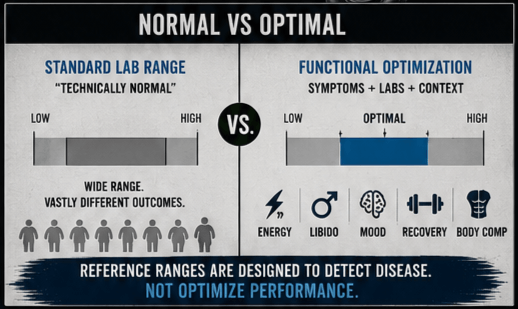
“Normal” Doesn’t Always Mean Optimal
I was in my early 40s when a friend suggested I get my testosterone checked. Why? I just felt… off. And every attempt to “get back into shape” felt like pushing a car uphill.
I assumed: “This is just aging.”
My regular doctor ran labs every year. Everything came back: “Normal.” That word does a tremendous amount of work in modern medicine. And very little of it helps a man trying to function at a high level.
So eventually I went to a physician who specialized in men’s hormonal health. For the first time, someone explained my labs: In context. Not just against a giant statistical reference range. My levels weren’t catastrophic. But they were low enough to matter. And this was nearly fifteen years ago – before TRT became mainstream internet content.
Back then, most people only associated testosterone with:
- steroid scandals
- professional sports
- bodybuilders
So my reaction wasn’t excitement. It was confusion.
The Needle Fear
Then came the treatment conversation.
Creams. Injections. Needles.
I had never injected myself with anything in my life. And when I saw the giant harpoon needles some clinics still hand out in starter kits? I almost walked out. I’m assuming that I’m not the only one who had that moment.
So let me save some men unnecessary anxiety: The default TRT setup is NOT your only option.
There are:
- smaller gauge needles
- different injection frequencies
- alternative injection sites dramatically easier approaches
- subcutaneous protocols
If fear of injections is stopping you from exploring TRT, talk to your provider before assuming the entire process isn’t for you. Because some clinics are still operating like it’s 1998.
TRT Didn’t Change My Life
And this is where my story diverges sharply from internet TRT marketing. For the next seven years: My body did not dramatically transform.
Some things improved.
- energy improved
- recovery improved
- overall wellbeing improved
But I did NOT suddenly become the version of myself I imagined. Why? Because I was still:
- drinking regularly
- inconsistent in the gym
- undereducated about nutrition
- not prioritizing sleep
- not building disciplined routines
- not training with structure or intent
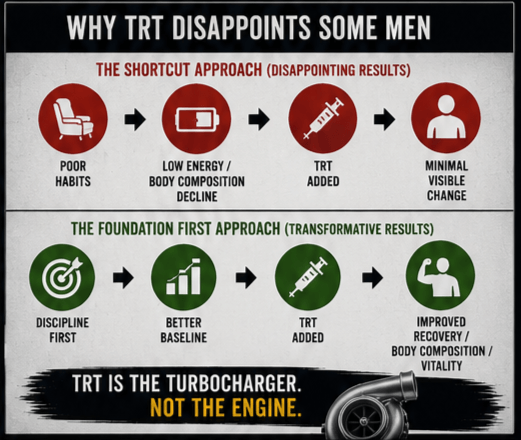
I optimized one variable. While neglecting the rest of the system. And this is the part most clinics and influencers do not explain clearly enough.
TRT DOES NOT REPLACE DISCIPLINE
This is the part the ads conveniently leave out.
Testosterone replacement therapy does NOT:
- change your habits
- change your discipline
- change your nutrition
- change your consistency
- change your behavior
And unless you’re already training intelligently and living reasonably well? TRT alone may not dramatically change your physique either. In some cases, it can even complicate hormonal management.
Men carrying higher amounts of visceral fat often have increased aromatase activity – meaning more testosterone converts into estradiol. That’s not a good thing. Research consistently links obesity with altered hormonal signaling and increased aromatase expression in men.
Translation? If your:
- sleep is terrible
- body fat is high
- nutrition is poor
- alcohol intake is excessive
…TRT alone may not fix much. That’s not a failure of testosterone. That’s misunderstanding what testosterone actually is.
“TRT is the amplifier. Not the foundation.”
My Hormones Changed Earlier. My Life Changed When My Habits Did.
Everything finally changed roughly seven years after I started TRT. That’s when I finally aligned:
- the morning routine
- journaling
- removing alcohol
- understanding calories and macros
- consistent resistance training
- sleep
- structure
- intentional habits
And once all of THAT aligned? The testosterone finally had something to work with. It was like having a high-performance engine sitting in a car with four flat tires. The engine had been there the whole time. The rest of the vehicle finally got fixed.
The Stigma Problem
Why the TRT Conversation Gets Distorted
This is where a lot of men either:
- avoid legitimate help
- misunderstand hormone therapy entirely
- dismiss the results of men who genuinely needed optimization
The most common reaction I hear is: “Well obviously you look like that. You’re on steroids.” And honestly? Fifteen years ago, I probably would’ve said the same thing. Because most people do not understand the difference between:
- hormone replacement therapy
- supraphysiological anabolic steroid use
Those are NOT the same thing. Not remotely.
The Cholesterol Analogy
This is the analogy that cuts through the noise best.
My natural LDL cholesterol sits around 105 without medication. My doctor prescribes something to optimize it. Nobody says: “That’s cheating.” Nobody says: “You should just accept your genetics.”
But somehow testosterone gets treated differently.
If one man naturally peaks at: 900 ng/dL…and another naturally peaks at: 400 ng/dL…why is only one considered “natural” while the other is reckless for trying to optimize?
Neither man chose his baseline.
The inconsistency around hormonal optimization compared to every other form of medical optimization is one of the stranger double standards in modern men’s health.
Testosterone Is About More Than Muscle
Longevity, Metabolic Health, and Quality of Life
Low testosterone is associated in research with:
- metabolic syndrome
- type 2 diabetes
- cardiovascular risk
- reduced quality of life
- increased mortality risk
Research examining testosterone quintiles repeatedly shows that men with healthier endogenous testosterone levels often demonstrate:
- lower rates of comorbidities
- better metabolic outcomes
- improved vitality markers
Healthy testosterone levels are tied to:
- energy
- cognition
- recovery
- lean mass retention
- bone density
- metabolic health
- overall vitality
The physique improvements are almost secondary.
Let’s Be Honest About Vanity
Most men initially explore TRT because they want to:
- look better
- feel younger
- regain confidence
- stop feeling invisible
- lean out
- perform better
And honestly? I don’t think that’s a problem. Because if vanity gets a man into:
- the gym
- healthier eating
- better sleep
- more discipline
- reduced alcohol intake
…the physiological benefits are still real.
The body doesn’t grade your motives. It responds to your actions.
“The body doesn’t grade your motives. It responds to your actions.”
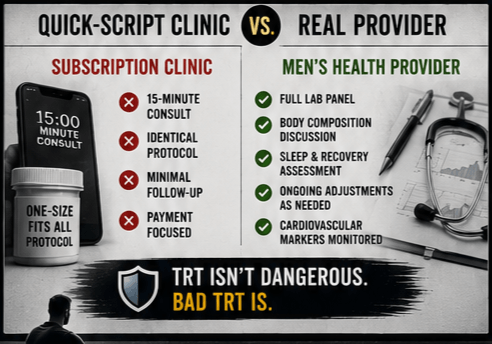
Choosing a TRT Provider Carefully
If you’re considering TRT, here’s my honest advice.
Be your own advocate.
Read actual research. Be skeptical of:
- social media certainty
- influencer protocols
- miracle claims
Look for:
- physicians who specialize in this. And your PC might not be the ideal provider.
- endocrinologists
- evidence-based providers
Not internet personalities trying to sell identities.
Choose your provider carefully.
Some clinics genuinely care about:
- long-term outcomes
- cardiovascular health
- hormonal balance
- body composition
- blood work trends
Others are essentially:
Subscription businesses.
That’s reality.
Ask questions.
The standard protocol is NOT the only protocol.
The goal isn’t:
“Getting a prescription.”
The goal is finding an approach that genuinely improves:
- health
- function
- quality of life
- long-term outcomes
That’s the actual objective.
What Really Matters
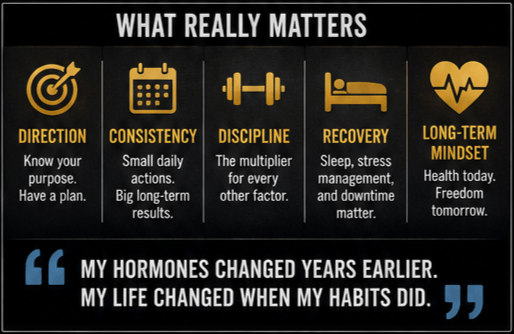
At the end of all this? The biggest transformations I’ve seen in myself and other men came from combining:
- discipline
- training
- nutrition
- recovery
- consistency
- hormonal optimization when appropriate
Not from hormones alone.
Final Thoughts
If you don’t want to spend hundreds of hours researching:
- hormones
- blood work
- nutrition
- recovery
- body composition
…find someone you trust who has actually lived through the process honestly.
Because testosterone replacement therapy is neither: Magic. Nor: Evil.
It’s one variable. And your results will always depend on the rest of the equation.
Research & Clinical References
Not influencer clips. Actual medical and clinical resources.
- Mayo Clinic — Testosterone therapy: Potential benefits and risks for aging men
https://www.mayoclinic.org/healthy-lifestyle/sexual-health/in-depth/testosterone-therapy/art-20045728 - Cleveland Clinic — Low Testosterone (Low T): Causes, Symptoms & Treatment
https://my.clevelandclinic.org/health/diseases/15285-low-testosterone - National Institutes of Health — Obesity in men: the hypogonadal-estrogen receptor relationship and its effect on glucose homeostasis
https://pmc.ncbi.nlm.nih.gov/articles/PMC8603736/ - Journal of Clinical Endocrinology & Metabolism — Testosterone, obesity, and metabolic syndrome associations in aging men
https://academic.oup.com/jcem - American Urological Association — Testosterone Deficiency Guideline
https://www.auanet.org/guidelines-and-quality/guidelines/testosterone-deficiency-guideline
About Norm Rieger
Norm Rieger is a men’s lifestyle coach, speaker, entrepreneur, and author of The New Norm — a project focused on helping men over 40 rebuild their health, physique, discipline, and mindset.
After transforming his own life later in adulthood, Norm now works with men looking for practical, honest guidance around:
- body composition
- fitness
- recovery
- hormones
- nutrition
- long-term health optimization
“My hormones changed years earlier.My life changed when my habits did.”
Why Fad Diets Stop Working for Men Over 40
Why Every Fad Diet Works at First
And Why That’s Exactly the Problem.
By Norm Rieger | The New Norm
“Every successful diet creates a caloric deficit. Everything else is branding.”
The Diet Industry Runs on Your Confusion
Keto. Intermittent fasting. Carnivore. Whole30. South Beach. The Zone. Atkins. Every few years a new diet arrives wrapped in:
- dramatic before-and-after photos
- celebrity endorsements
- aggressive certainty
- people claiming they finally found “the secret”
And here’s the uncomfortable truth:
They usually DO work.
At first. That’s the part that keeps the entire industry alive.
Every Diet Works Through the Same Mechanism
Here’s what almost nobody in the diet business wants to say clearly:
Fat loss has one non-negotiable requirement. You must consume fewer calories than your body burns.
That’s the mechanism.
Not keto. Not fasting. Not avoiding gluten. Not eating like a caveman. Not “resetting your metabolism.”
A caloric deficit is the actual driver.
Every legitimate fat-loss study eventually circles back to the same conclusion:
The diet is just the delivery vehicle.

Why Fad Diets Produce Fast Early Results
Because most of them accidentally reduce calories. That’s it.
Keto?
You eliminated a major calorie source. In fact, an ENTIRE MACRONUTRIENT GROUP!
Intermittent fasting?
You reduced your eating opportunities.
Whole30?
You removed highly processed calorie-dense foods.
Carnivore?
Protein and fat tend to increase fullness naturally.
Different rules. Same outcome. *Until the calories from fats sneak up on you.
All of the above = Reduced energy intake.
“The magic isn’t in the diet. The magic is in the deficit.”
Then the Diet “Stops Working”
This is where almost everybody gets frustrated. The early results feel like proof you found THE answer. You didn’t. You found a temporary structure that created a caloric deficit. Then two predictable things happen.
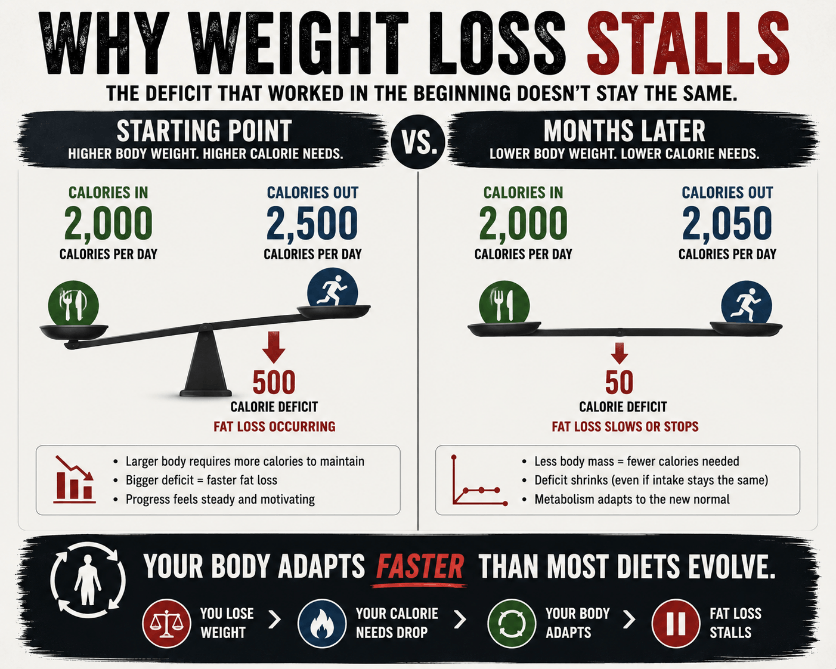
Problem #1: Your Body Adapts
As you lose weight:
- your body becomes smaller
- maintenance calories decrease
- energy expenditure drops
- the original deficit shrinks
Meaning:
The calorie gap that caused fat loss gradually disappears. Progress slows. Then stalls. Most people blame the diet. But the diet didn’t stop working.
The deficit disappeared.
Problem #2: The Rules Eventually Break
Most fad diets are built around: restriction. Not education. They tell you:
- what to eliminate
- what to fear
- what foods are “bad”
But they rarely teach:
- calorie awareness
- protein targets
- sustainability
- flexibility
- how to eat in real life
So eventually:
- vacation happens
- stress happens
- holidays happen
- work gets chaotic
- family dinners happen
And the structure collapses. Not because you’re weak. Because you never actually learned the mechanism. You learned rules.
“A script works until real life improvises.”
This Is Why the Diet Industry Never Dies
Because failure creates repeat customers. The cycle looks like this:
Diet → Early Results → Plateau → Frustration → New Diet
And every time: the customer blames themselves.
Not the fact they were sold:
- restriction
- excitement
- novelty
- temporary structure
…instead of understanding. That’s an incredibly profitable business model.
Calories Matter Most — But Macros Still Matter
Now let’s make an important distinction. Calories drive fat loss. But:
Macros determine what you look like when you get there.
That matters. Because losing 30 pounds while:
- losing muscle
- feeling exhausted
- staying hungry
- looking soft
…is very different from:
- preserving muscle
- improving body composition
- maintaining energy
- staying strong
Protein Is the Anchor
For men over 40, protein matters more than almost every other nutritional variable. Why?
Because protein:
- preserves lean tissue
- increases satiety
- supports recovery
- costs more energy to digest
- helps control hunger during deficits
You absolutely CAN lose weight eating junk food if the calories are low enough. But the result usually looks terrible. And feels terrible.
The Men Who Finally Get Lean Understand One Thing
They stop chasing diets. And start understanding systems. That’s the shift.
Once you understand:
- caloric deficit
- protein intake
- resistance training
- sustainability
- behavior patterns
…the specific “diet” becomes far less important.
Now you can:
- use intermittent fasting strategically
- enjoy lower-carb eating if you prefer it
- structure meals however you want
- eat flexibly during travel or holidays
…without feeling like the entire system collapses. Because now you understand WHY it works.
“Understanding beats restriction every time.”
So What Actually Matters?
If your goal is sustainable fat loss after 40, focus on:
1. A sustainable caloric deficit
2. High protein intake
3. Resistance training
4. Consistency over perfection
5. A structure you can maintain during real life
That’s the formula. Not a magical eating window. Not a special food list. Not “metabolic confusion.” Just physiology.
Final Thoughts
I’m not anti-diet. If a structure helps you:
- control calories
- reduce overeating
- improve consistency
- simplify decisions
…great. Use it. But understand: The structure is not the mechanism. That distinction changes everything.
Because once you understand what’s actually driving the results, you stop jumping from one nutritional religion to another every six months. And that’s usually the moment body composition finally starts becoming sustainable.
Research & Clinical References
Not diet industry marketing. Actual physiology.
- National Institutes of Health — Energy balance and body weight regulation
https://www.ncbi.nlm.nih.gov - American Journal of Clinical Nutrition — Protein intake and body composition during caloric restriction
https://academic.oup.com/ajcn - Obesity Reviews — Adaptive thermogenesis during weight loss
https://onlinelibrary.wiley.com/journal/1467789x - Frontiers in Nutrition — Protein intake and muscle preservation in aging adults
https://www.frontiersin.org - Harvard T.H. Chan School of Public Health — Dietary patterns and sustainability research
https://www.hsph.harvard.edu
About Norm Rieger
Norm Rieger is a men’s lifestyle coach, speaker, entrepreneur, and author of The New Norm — a project focused on helping men over 40 rebuild their health, physique, discipline, and mindset.
After transforming his own life later in adulthood, Norm now works with men looking for practical, honest guidance around fitness, body composition, nutrition, habits, recovery, and long-term health optimization.
“The diet industry sells rules.Biology runs on principles.”
How Much Protein Do Men Over 50 Actually Need?
Sick of Hearing About Protein? Good.
Here’s What’s Actually True for Men Over 50.
By Norm Rieger | The New Norm
“Most men over 50 aren’t eating too much protein. They’re eating too little — and timing it badly.”
Protein Has Become Fitness White Noise
Shakes. Scoops. Influencers. Gym bros arguing over decimal points.
At this point, most men over 50 are either:
- exhausted by the conversation
- confused by conflicting advice
- under-eating protein entirely
- or chasing targets designed for 24-year-old bodybuilders living on chicken and rice
The irony?
Despite all the noise, most men in their 40s, 50s, and 60s still do not understand the few things about protein that actually matter.
And unfortunately, those details matter more as you age.
The Government Protein Recommendation Is a Survival Number
Let’s start with the number everyone quotes.
The current Recommended Dietary Allowance (RDA) for protein is:
Roughly 0.35 grams per pound of body weight per day
For a 180-pound man? That’s roughly 65 grams of protein daily. Now here’s the important part. That number was never designed to optimize:
- muscle retention
- body composition
- recovery
- performance
- healthy aging
- resistance training outcomes
It was designed to prevent deficiency.
That’s a completely different objective.
The Problem Men Over 50 Face: Anabolic Resistance
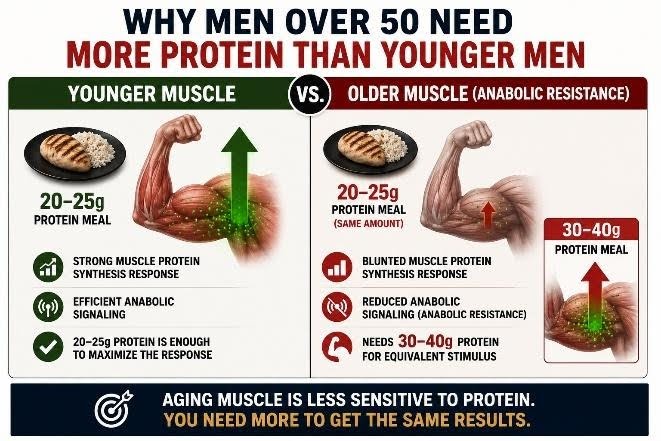
This is the physiological reality almost nobody explains properly. As men age, muscle tissue becomes less responsive to protein.
Researchers call this: Anabolic Resistance
In younger men: 20–25 grams of protein may strongly stimulate muscle protein synthesis. In older men? That same amount often produces a weaker response.
Meaning, men over 50 frequently require:
- more protein per meal
- higher total daily intake
- better protein distribution
…to achieve the same anabolic effect younger men get automatically.
This is one of the most important concepts in aging nutrition. And most men have never heard the term.
“Older muscle needs a louder signal.”
Protein needs increase with age — not decrease.
The Research Is Actually Pretty Clear
A 2014 review published in Frontiers in Nutrition concluded that the current RDA is insufficient for optimizing health and protecting older adults against sarcopenia.
A 2022 systematic review and meta-analysis published in the International Journal of Environmental Research and Public Health found that older adults with sarcopenia consistently consumed less protein than peers without it.
The evidence repeatedly points in the same direction:
Older adults need more protein than the minimum government recommendation.
Not less.
So How Much Protein Do Men Over 50 Actually Need?
That depends entirely on the goal. Not every man needs bodybuilding-level intake.
But almost every active man over 50 needs more than he thinks.
Goal #1: Fat Loss While Preserving Muscle
This is where protein becomes extremely important. Because during a caloric deficit, your body can pull energy from fat tissue and muscle tissue.
Adequate protein helps preserve lean mass while dieting.
Research consistently supports:
Roughly 0.75–0.85 grams per pound of body weight daily
…for active individuals trying to lose fat while retaining muscle.
For a 180-pound man? That’s approximately:
130–155 grams daily
In practical coaching terms? I often simplify it to: “Aim for roughly one gram per pound of target body weight during a cut.”
Not because it’s mathematically perfect.
Because it’s practical. Reliable. Easy to remember. And safely above the evidence-based floor.
Goal #2: Maintenance and Healthy Aging
If the goal is simply:
- staying strong
- maintaining muscle
- aging well
- preserving metabolic health
…the research still supports intake above the RDA.
Most evidence points toward:
Roughly 0.45–0.6 grams per pound daily
…combined with resistance training.
That places most active men over 50 somewhere around:
85–110 grams daily
…depending on body size and activity level.
This is where many men unintentionally under-eat.
Especially when appetite decreases with age.
Goal #3: Building Muscle After 50
This is where the internet gets especially noisy.
The research-supported range for muscle growth generally lands around:
Roughly 0.75–1+ gram per pound daily
Most evidence suggests diminishing returns beyond that range.
Meaning:
The protein industry’s obsession with endlessly increasing intake often has more to do with selling tubs than improving outcomes.
That doesn’t mean higher protein is dangerous.
It means:
More is not automatically better.
Especially if total calories, training quality, sleep, and recovery are poor.
“Protein supports muscle growth. It does not replace progressive overload.”
The Biggest Mistake Most Men Make
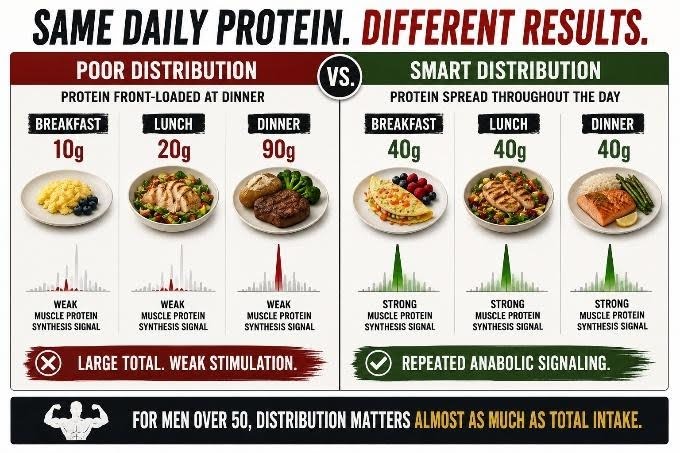
Even men hitting decent daily totals often distribute protein terribly. This matters. Because anabolic resistance is affected by:
- total daily intake
- per-meal intake
- meal timing
A man eating:
- 10g at breakfast
- 20g at lunch
- 90g at dinner
…is not stimulating muscle protein synthesis as effectively as someone eating:
- 35–45g across 3–4 meals
The per-meal threshold matters. Especially over 50.
Why Animal Protein Usually Wins
The research consistently favors complete protein sources for muscle protein synthesis.
That means:
- meat
- eggs
- fish
- poultry
- dairy
These contain all essential amino acids, including: Leucine. Leucine is one of the primary triggers for activating muscle protein synthesis.
Plant proteins can absolutely work. But they often require:
- higher total intake
- better food combining
- more intentional planning
…to reach equivalent anabolic stimulation.
That’s not ideology. That’s amino acid composition.
“And there’s nothing wrong with protein shakes or powders. For most of us, we need these to help us reach our protein goals. As long as the majority of your protein comes from whole foods with essential aminos acids, these products help get us there!”
The Kidney Myth Needs to Die
This comes up every single time protein gets discussed. “Too much protein damages your kidneys.” For healthy individuals with normal kidney function? The evidence does not support this fear.
Multiple reviews have found no evidence that protein intakes up to roughly 1 gram per pound of body weight per day damage kidney function in healthy adults.
Now if someone already has:
- kidney disease
- impaired renal function
- significant medical complications
…that becomes an individual medical conversation. But healthy active adults should stop being terrified of chicken breast.
The Practical Takeaway
Here’s the simplest version.
Fat loss with muscle retention? Roughly 0.75–0.85 grams per pound daily
Maintenance and healthy aging? Roughly 0.45–0.6 grams per pound daily
Active muscle building? Roughly 0.75–1+ gram per pound daily
Then:
- distribute protein across 3–4 meals
- prioritize whole food protein
- resistance train consistently
- stop obsessing over perfection
Because consistency beats optimization theater. Every time.
“Most men over 50 are under-muscled long before they’re over-proteined.”
Final Thoughts
Protein is not magic. But it is one of the few things in nutrition where the evidence is remarkably consistent.
As men age:
- muscle becomes harder to maintain
- anabolic signaling weakens
- recovery changes
- inactivity becomes more expensive metabolically
Protein helps offset that reality. Not by itself. But as part of the full system.
And once men finally understand that protein is not just a bodybuilding conversation — but an aging conversation — the entire topic starts making a lot more sense.
Research & Clinical References
Not supplement marketing. Actual literature.
- Frontiers in Nutrition — Protein requirements and aging muscle
https://www.frontiersin.org - International Journal of Environmental Research and Public Health — Protein intake and sarcopenia risk in older adults
https://www.mdpi.com/journal/ijerph - Nutrition & Metabolism — Aging muscle and anabolic resistance research
https://nutritionandmetabolism.biomedcentral.com - American Journal of Clinical Nutrition — Per-meal protein thresholds in older adults
https://academic.oup.com/ajcn - British Journal of Sports Medicine — Morton et al. protein meta-analysis
https://bjsm.bmj.com - ESPEN Guidelines — Protein intake recommendations for older adults https://www.espen.org
About Norm Rieger
Norm Rieger is a men’s lifestyle coach, speaker, entrepreneur, and author of The New Norm — a project focused on helping men over 40 rebuild their health, physique, discipline, and mindset.
After transforming his own life later in adulthood, Norm now works with men looking for practical, honest guidance around fitness, body composition, nutrition, habits, recovery, and long-term health optimization.
“The goal isn’t eating like a bodybuilder. The goal is not aging like a sedentary man.”
Why Cardio Won’t Make You Lean | The Truth About Fat Loss
Cardio Is the Great Pretender
The Truth About Fat Loss Most Men Never Figure Out
By Norm Rieger | The New Norm
“You cannot out-run a fork or a bottle. That’s not motivation. That’s math.”
The Loaf of Bread Analogy That Changes Everything
I want you to picture a loaf of bread. A good one. Twenty slices. That loaf represents every calorie your body burns in a day. Your total daily energy expenditure.
Now here’s the part most people never understand. About fourteen of those slices disappear before you even get out of bed.
That’s:
- your heart beating
- your lungs breathing
- your liver filtering
- your brain functioning
- your kidneys working
- your body keeping you alive
Existing is expensive. Another three or four slices disappear through basic daily movement:
- walking
- standing
- climbing stairs
- fidgeting
- digesting food
That’s normal life. Not exercise. By the time you actually lace up your sneakers and go for a 30-minute jog? You’re fighting over the last two slices.
That’s the part most men completely misunderstand.
Where Your Daily Calorie Burn Actually Comes From
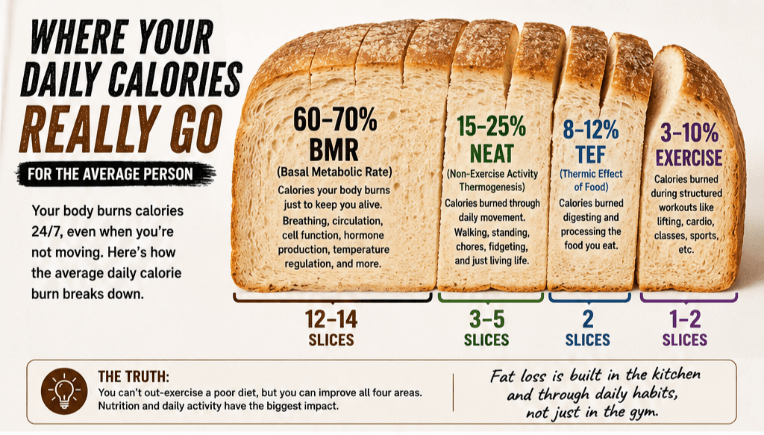
A 20-slice loaf of bread divided visually:
- 14 slices labeled: BMR / Staying Alive Heart • brain • organs • breathing
- 4 slices labeled: Daily Movement (NEAT) Walking • chores • stairs • movement
- 2 slices labeled in bold red: Exercise / Cardio Jogging • treadmill • spin class
“Most men try to lose fat by attacking the smallest slice of the pie.”
Exercise matters for health. Nutrition controls fat loss.
Cardio Only Controls a Small Percentage of Fat Loss
A 180-pound man jogging at a moderate pace for thirty minutes burns roughly 300–350 calories according to Harvard Medical School estimates.
That sounds meaningful. Until you realize it often represents only about 10–15% of total daily energy expenditure for most men in midlife. Then you go home feeling accomplished and hungry. And your body quietly nudges you to eat more.
Researchers refer to this as:
Metabolic Compensation
Your body is not trying to sabotage you. It’s trying to survive. When energy output rises, hunger signaling often rises with it. That’s one reason exercise-alone weight loss strategies frequently disappoint people over time.
“The body is always trying to close the energy gap.”
The Part Nobody Wants to Admit
Now flip the loaf over.
That same 300–350 calories? You can erase them in under five minutes. A sandwich. A couple glasses of wine. A bowl of pasta. A few handfuls of snacks while cooking dinner. Gone.
This is why I keep repeating:
“You can’t out-train a fork.”
Not because cardio is useless. Because the arithmetic is brutally one-sided. The calories you can consume are enormous compared to the calories you can realistically burn through exercise.
Cardio Is Healthy. It’s Just Misunderstood.
Before people hear this the wrong way: cardio absolutely matters.
Cardiovascular exercise improves:
- heart health
- insulin sensitivity
- blood pressure
- stress management
- mitochondrial function
- sleep quality
- longevity
A 2021 systematic review and meta-analysis involving more than 60 randomized controlled trials confirmed that exercise significantly reduces visceral fat and improves cardiometabolic health markers compared to sedentary controls.
Those benefits are real. Important. Potentially life-saving.
But Cardio Was Never Meant to Be the Primary Fat Loss Engine
That job belongs primarily to:
Nutrition
Because fat loss ultimately comes down to: Energy Balance
Calories in. Calories out. The deficit matters. And the largest, most controllable variable in that equation is almost always food intake. Not treadmill output.
The Orange Juice Example
To burn the calories in a single glass of orange juice:
A 180-pound man would need to jog for roughly 10–12 minutes.
To simply not drink it? About one second.
Both create approximately the same caloric deficit.
One requires:
- time
- sweat
- elevated appetite afterward
- recovery
The other requires a decision. That doesn’t mean orange juice is evil. It means understanding the math changes your priorities.
Why Exercise-Only Weight Loss Usually Fails
Large observational studies tracking runners and walkers over multiple years have repeatedly shown that relying primarily on exercise for weight management often results in:
- stalled progress
- partial regain
- compensation eating
- plateaued body composition
Not because exercise is ineffective. Because the body adapts. The harder you push energy expenditure, the more your body often pushes back through:
- hunger
- fatigue
- reduced spontaneous movement
- metabolic adaptation
Understanding this changes everything.
So What Actually Works?
The men who finally transform their body composition usually make one critical mental shift:
They stop treating cardio as the main event. And start treating nutrition as the foundation.
The hierarchy looks more like this:
1. Nutrition controls fat loss.
2. Resistance training preserves and builds muscle.
3. Cardio supports heart health and assists the deficit.
That’s the actual order. Not the other way around.
Why Resistance Training Matters More Than Most Men Think
Cardio burns calories temporarily. Muscle changes the entire equation.
Resistance training helps:
- preserve lean tissue during dieting
- improve insulin sensitivity
- increase resting metabolic rate
- improve glucose disposal
- create a stronger metabolic baseline
More muscle slightly enlarges the entire loaf. Which gives you more room to work with nutritionally. That’s why the men who finally get lean usually stop living on treadmills and start training with intent.
“The fat loss is in the kitchen. The muscle is in the weight room. The cardio is for your heart.”
The Spin Class Reality Check
If you’re standing in the back of a packed spin class, drenched in sweat, waiting for a six-pack to emerge while your nutrition remains inconsistent…
You are working very hard in the wrong room. That’s not criticism. It’s clarity.
Because once men understand where energy expenditure actually comes from, they stop wasting years trying to force cardio to do a job nutrition was always responsible for.
And weirdly? That realization usually makes fitness less miserable.
Final Thoughts
Cardio is not the villain.
It’s one of the best things you can do for long-term health. But if your primary goal is body composition? You need to understand the hierarchy. Nutrition drives the deficit. Resistance training protects the muscle. Cardio supports the system.
Once you understand that, the whole picture changes. And once you see the loaf of bread clearly? You can’t really un-see it.
Research & Clinical References
Not fitness industry slogans. Actual research.
- Harvard Medical School — Estimated calorie expenditure from walking and running
https://www.health.harvard.edu - National Institutes of Health — Exercise, energy compensation, and appetite regulation
https://pmc.ncbi.nlm.nih.gov - Obesity Journal — Long-term weight change in runners and walkers
https://onlinelibrary.wiley.com/journal/1930739x - Systematic Review & Meta-Analysis — Exercise and visceral fat reduction outcomes
https://pubmed.ncbi.nlm.nih.gov - American College of Sports Medicine — Resistance training and metabolic health position stand
https://www.acsm.org
About Norm Rieger
Norm Rieger is a men’s lifestyle coach, speaker, entrepreneur, and author of The New Norm — a project focused on helping men over 40 rebuild their health, physique, discipline, and mindset.
After transforming his own life later in adulthood, Norm now works with men looking for practical, honest guidance around fitness, body composition, nutrition, habits, recovery, and long-term health optimization.
“Sweating harder and eating smarter are not the same thing.”
Is Alcohol Worse Than Diet Soda for Men Over 40?
Diet Soda vs. Alcohol
Which One Is Actually Worse for Men Over 40?
By Norm Rieger | The New Norm
“One gets treated like poison. The other gets handed out at every celebration.”
The Double Standard Nobody Questions
If you’ve ever opened a Diet Coke while someone next to you ordered a second bourbon and looked at YOU like you were making the unhealthy choice, you’ve experienced one of the strangest double standards in modern health culture.
Diet soda gets discussed like: Liquid poison!
Meanwhile alcohol gets framed as:
- social
- sophisticated
- deserved
- relaxing
- normal
Even when it’s consumed far more aggressively. This article isn’t about morality. And it’s definitely not about pretending nobody should ever drink.
It’s about:
What actually matters biologically.
Especially for men over 40 trying to:
- stay lean
- preserve testosterone
- recover better
- sleep better
- build muscle
- manage body fat
Because culturally popular and physiologically harmless are not always the same thing.
Let’s Start With the Thing Everyone Panics About
Diet soda. More specifically: Artificial sweeteners.
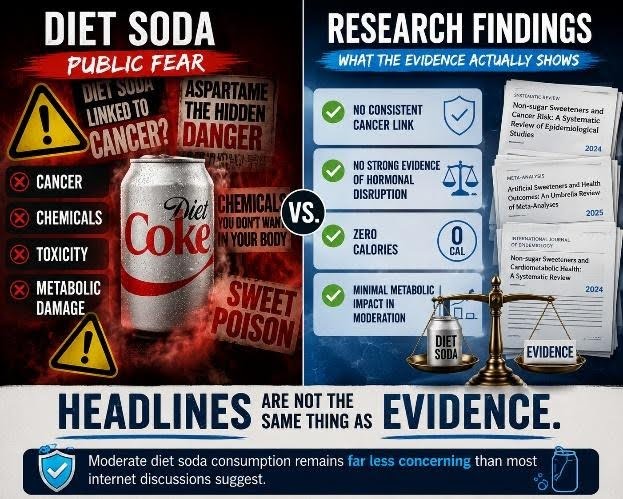
Aspartame gets discussed online like it’s industrial coolant mixed with pesticide and regret. But once you step away from social media panic and actually look at the literature? The picture changes dramatically.
What the Research Actually Says About Diet Soda
The biggest concerns around artificial sweeteners generally center around:
- cancer risk
- metabolic disruption
- insulin response
- gut microbiome changes
Those are legitimate things to study. But studying a possibility and proving harm are not the same thing.
A 2024 systematic review examining 90 epidemiological studies across multiple sweetener categories and 17 cancer types found: No consistent association between artificial sweeteners and cancer.
A 2025 umbrella meta-analysis reviewing ten separate meta-analyses reached essentially the same conclusion. That doesn’t mean the science is “settled forever.” Science rarely works that way. It means the current weight of evidence does not support the hysteria.
Are There Still Open Questions?
Absolutely. There are still reasonable discussions around:
- gut microbiome effects
- appetite regulation
- insulin signaling
- long-term behavioral effects
And if someone personally feels better avoiding artificial sweeteners? Great. No issue, but we need to separate preference from proven physiological harm.
Those are not the same thing.
“The internet and network news often confuses possibility with proof.”
Now Let’s Talk About Alcohol
Because this is where the conversation suddenly becomes awkward. Alcohol gets treated very differently socially.
People rarely say: “You still drink wine? Aren’t you worried about your health?”
…with the same intensity they attack artificial sweeteners.
But from the perspective of:
- body composition
- hormones
- recovery
- sleep
- fat loss
…the evidence around alcohol is dramatically more concerning.
Alcohol Quietly Destroys Deficits
This is the first major issue.
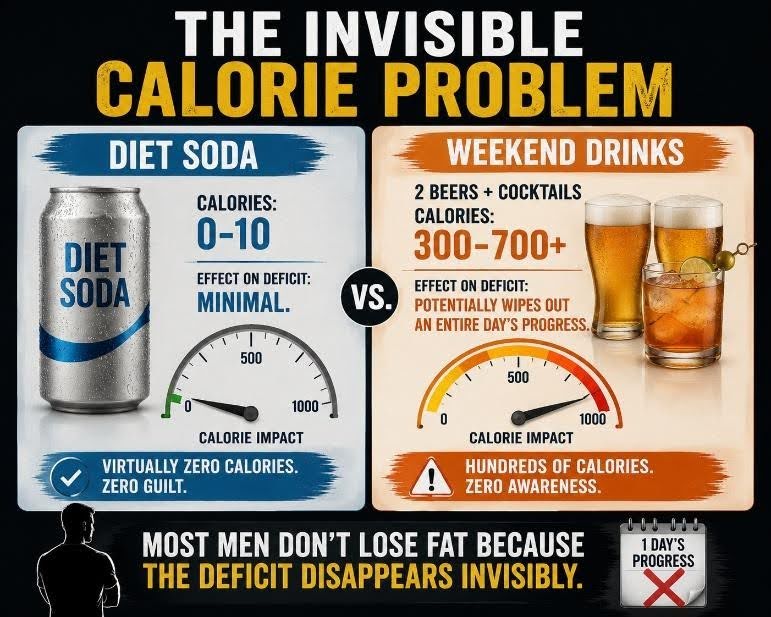
Alcohol contains: 7 calories per gram.
Almost as calorie-dense as fat.
But unlike protein or carbohydrates:
- it doesn’t support recovery
- it doesn’t support muscle
- it doesn’t meaningfully increase satiety
A couple drinks can quietly erase a caloric deficit extremely fast.
Especially when alcohol lowers food restraint afterward. For men trying to lose body fat after 40? This is often the hidden variable sabotaging progress.
Alcohol and Testosterone
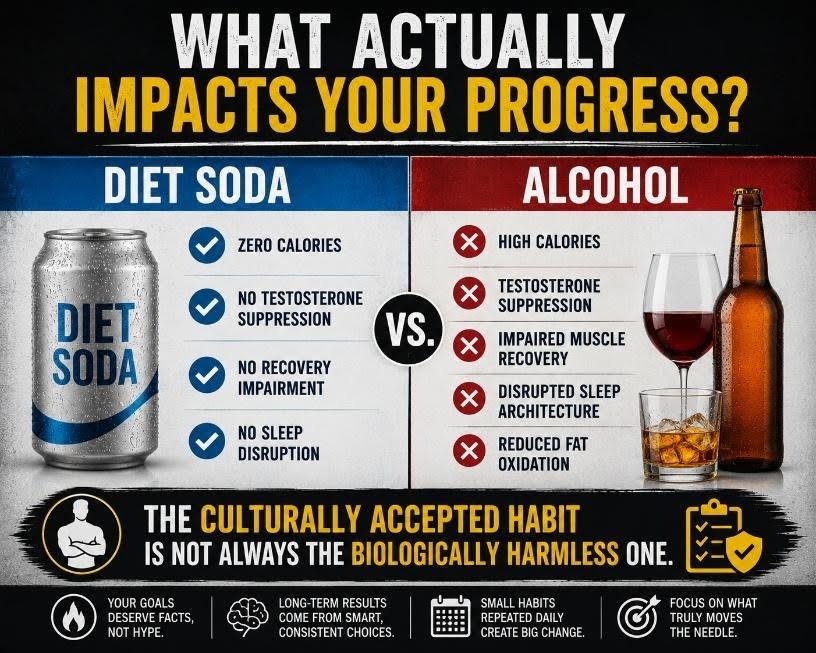
This part matters even more for middle-aged men. Testosterone already declines gradually with age. The hormonal environment after 40 is not the same as it was at 25. Research consistently shows that heavier alcohol intake suppresses testosterone production.
One controlled study demonstrated approximately:
20–23% testosterone suppression following heavy alcohol intake.
Now to be fair, that does NOT mean: “One drink destroys your hormones.”
Context matters. Moderate occasional drinking is not the same thing as regular heavier intake. But pretending alcohol is physiologically neutral for hormones also isn’t accurate.
Alcohol and Muscle Recovery
This is another area most men underestimate.
Post-workout alcohol consumption has been shown to reduce muscle protein synthesis significantly.
Meaning: if you trained hard Friday night and drank heavily afterward? You partially blunted the adaptation you just worked for. That’s not internet bro-science. That’s documented physiology.
“You can train hard and still quietly undermine recovery afterward.”
The Sleep Problem Is Bigger Than Most Men Realize
A lot of people think alcohol helps sleep because it helps them fall asleep faster. But quality sleep and unconsciousness are not identical.
Alcohol disrupts:
- REM sleep
- slow-wave sleep
- recovery quality
- overnight hormonal regulation
Which often leads to:
- elevated cortisol
- worse recovery
- increased hunger the next day
- lower training performance
- worse decision-making
This is one reason men often feel flatter, puffier, softer, and less recovered after consistent drinking periods. Even if calories remain similar.
So Is Diet Soda “Healthy”?
That depends how you define healthy. Water is obviously the superior choice overall. Nobody’s arguing otherwise. But the internet often frames diet soda like it’s worse than actual physiologically damaging habits. And based on current evidence? That simply doesn’t hold up.
Especially when compared directly against:
- regular heavier drinking
- excess calories from alcohol
- impaired recovery
- hormonal suppression
- sleep disruption
This Isn’t an Anti-Alcohol Sermon
That’s important. I’m not trying to turn this into: “Alcohol is evil.” Many people drink moderately and maintain excellent health.
I personally stopped drinking entirely and it was one of the best decisions I ever made for:
- recovery
- body composition
- clarity
- discipline
- consistency
But that’s my experience.
The point is proportionality. If someone wants to enjoy a few drinks intentionally? Fine. Just understand the tradeoffs honestly.
“Know what you’re choosing and what it costs.”
Final Thoughts
If your goal is optimizing:
- body composition
- hormones
- recovery
- sleep
- energy
…then alcohol deserves far more scrutiny than diet soda.
Not because drinking occasionally makes someone unhealthy. But because the physiological effects are real, measurable, and often underestimated.
Meanwhile the fear around moderate diet soda intake is often driven far more by cultural panic than by the actual weight of evidence. And honestly? Middle-aged men already have enough real biological challenges to manage without inventing imaginary ones.
Research & Clinical References
Not social media panic. Actual research.
- Systematic review — Artificial sweeteners and cancer associations
https://pubmed.ncbi.nlm.nih.gov - Umbrella meta-analysis — Non-sugar sweeteners and health outcomes
https://pubmed.ncbi.nlm.nih.gov - National Institutes of Health — Alcohol and testosterone suppression
https://www.ncbi.nlm.nih.gov - PLOS ONE — Alcohol ingestion and muscle protein synthesis after exercise
https://journals.plos.org/plosone - Sleep Foundation — Alcohol and sleep architecture disruption
https://www.sleepfoundation.org
About Norm Rieger
Norm Rieger is a men’s lifestyle coach, speaker, entrepreneur, and author of The New Norm — a project focused on helping men over 40 rebuild their health, physique, discipline, and mindset.
After transforming his own life later in adulthood, Norm now works with men looking for practical, honest guidance around fitness, body composition, nutrition, habits, recovery, and long-term health optimization.