
“You cannot out-run a fork or a bottle. That’s not motivation. That’s math.”
The Loaf of Bread Analogy That Changes Everything
I want you to picture a loaf of bread. A good one. Twenty slices. That loaf represents every calorie your body burns in a day. Your total daily energy expenditure.
Now here’s the part most people never understand. About fourteen of those slices disappear before you even get out of bed.
That’s:
- your heart beating
- your lungs breathing
- your liver filtering
- your brain functioning
- your kidneys working
- your body keeping you alive
Existing is expensive. Another three or four slices disappear through basic daily movement:
- walking
- standing
- climbing stairs
- fidgeting
- digesting food
That’s normal life. Not exercise. By the time you actually lace up your sneakers and go for a 30-minute jog? You’re fighting over the last two slices.
That’s the part most men completely misunderstand.
Where Your Daily Calorie Burn Actually Comes From
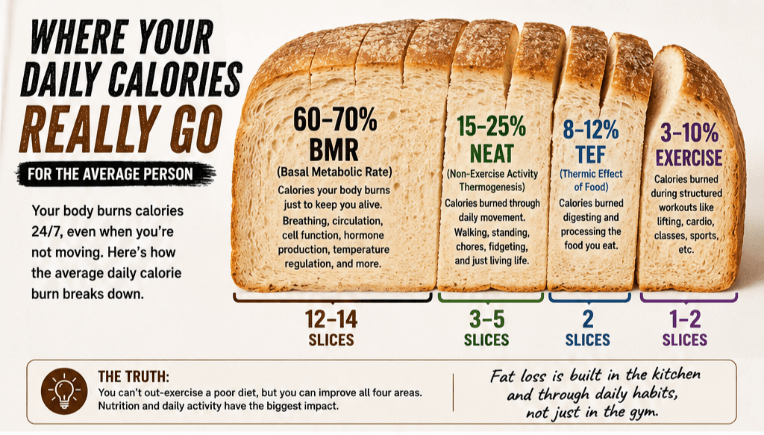
A 20-slice loaf of bread divided visually:
- 14 slices labeled: BMR / Staying Alive Heart • brain • organs • breathing
- 4 slices labeled: Daily Movement (NEAT) Walking • chores • stairs • movement
- 2 slices labeled in bold red: Exercise / Cardio Jogging • treadmill • spin class
“Most men try to lose fat by attacking the smallest slice of the pie.”
Exercise matters for health. Nutrition controls fat loss.
Cardio Only Controls a Small Percentage of Fat Loss
A 180-pound man jogging at a moderate pace for thirty minutes burns roughly 300–350 calories according to Harvard Medical School estimates.
That sounds meaningful. Until you realize it often represents only about 10–15% of total daily energy expenditure for most men in midlife. Then you go home feeling accomplished and hungry. And your body quietly nudges you to eat more.
Researchers refer to this as:
Metabolic Compensation
Your body is not trying to sabotage you. It’s trying to survive. When energy output rises, hunger signaling often rises with it. That’s one reason exercise-alone weight loss strategies frequently disappoint people over time.
“The body is always trying to close the energy gap.”
The Part Nobody Wants to Admit
Now flip the loaf over.
That same 300–350 calories? You can erase them in under five minutes. A sandwich. A couple glasses of wine. A bowl of pasta. A few handfuls of snacks while cooking dinner. Gone.
This is why I keep repeating:
“You can’t out-train a fork.”
Not because cardio is useless. Because the arithmetic is brutally one-sided. The calories you can consume are enormous compared to the calories you can realistically burn through exercise.
Cardio Is Healthy. It’s Just Misunderstood.
Before people hear this the wrong way: cardio absolutely matters.
Cardiovascular exercise improves:
- heart health
- insulin sensitivity
- blood pressure
- stress management
- mitochondrial function
- sleep quality
- longevity
A 2021 systematic review and meta-analysis involving more than 60 randomized controlled trials confirmed that exercise significantly reduces visceral fat and improves cardiometabolic health markers compared to sedentary controls.
Those benefits are real. Important. Potentially life-saving.
But Cardio Was Never Meant to Be the Primary Fat Loss Engine
That job belongs primarily to:
Nutrition
Because fat loss ultimately comes down to: Energy Balance
Calories in. Calories out. The deficit matters. And the largest, most controllable variable in that equation is almost always food intake. Not treadmill output.
The Orange Juice Example
To burn the calories in a single glass of orange juice:
A 180-pound man would need to jog for roughly 10–12 minutes.
To simply not drink it? About one second.
Both create approximately the same caloric deficit.
One requires:
- time
- sweat
- elevated appetite afterward
- recovery
The other requires a decision. That doesn’t mean orange juice is evil. It means understanding the math changes your priorities.
Why Exercise-Only Weight Loss Usually Fails
Large observational studies tracking runners and walkers over multiple years have repeatedly shown that relying primarily on exercise for weight management often results in:
- stalled progress
- partial regain
- compensation eating
- plateaued body composition
Not because exercise is ineffective. Because the body adapts. The harder you push energy expenditure, the more your body often pushes back through:
- hunger
- fatigue
- reduced spontaneous movement
- metabolic adaptation
Understanding this changes everything.
So What Actually Works?
The men who finally transform their body composition usually make one critical mental shift:
They stop treating cardio as the main event. And start treating nutrition as the foundation.
The hierarchy looks more like this:
1. Nutrition controls fat loss.
2. Resistance training preserves and builds muscle.
3. Cardio supports heart health and assists the deficit.
That’s the actual order. Not the other way around.
Why Resistance Training Matters More Than Most Men Think
Cardio burns calories temporarily. Muscle changes the entire equation.
Resistance training helps:
- preserve lean tissue during dieting
- improve insulin sensitivity
- increase resting metabolic rate
- improve glucose disposal
- create a stronger metabolic baseline
More muscle slightly enlarges the entire loaf. Which gives you more room to work with nutritionally. That’s why the men who finally get lean usually stop living on treadmills and start training with intent.
“The fat loss is in the kitchen. The muscle is in the weight room. The cardio is for your heart.”
The Spin Class Reality Check
If you’re standing in the back of a packed spin class, drenched in sweat, waiting for a six-pack to emerge while your nutrition remains inconsistent…
You are working very hard in the wrong room. That’s not criticism. It’s clarity.
Because once men understand where energy expenditure actually comes from, they stop wasting years trying to force cardio to do a job nutrition was always responsible for.
And weirdly? That realization usually makes fitness less miserable.
Final Thoughts
Cardio is not the villain.
It’s one of the best things you can do for long-term health. But if your primary goal is body composition? You need to understand the hierarchy. Nutrition drives the deficit. Resistance training protects the muscle. Cardio supports the system.
Once you understand that, the whole picture changes. And once you see the loaf of bread clearly? You can’t really un-see it.
Research & Clinical References
Not fitness industry slogans. Actual research.
- Harvard Medical School — Estimated calorie expenditure from walking and running
https://www.health.harvard.edu - National Institutes of Health — Exercise, energy compensation, and appetite regulation
https://pmc.ncbi.nlm.nih.gov - Obesity Journal — Long-term weight change in runners and walkers
https://onlinelibrary.wiley.com/journal/1930739x - Systematic Review & Meta-Analysis — Exercise and visceral fat reduction outcomes
https://pubmed.ncbi.nlm.nih.gov - American College of Sports Medicine — Resistance training and metabolic health position stand
https://www.acsm.org

About Norm Rieger
Norm Rieger is a men’s lifestyle coach, speaker, entrepreneur, and author of The New Norm — a project focused on helping men over 40 rebuild their health, physique, discipline, and mindset.
After transforming his own life later in adulthood, Norm now works with men looking for practical, honest guidance around fitness, body composition, nutrition, habits, recovery, and long-term health optimization.