
“One gets treated like poison. The other gets handed out at every celebration.”
The Double Standard Nobody Questions
If you’ve ever opened a Diet Coke while someone next to you ordered a second bourbon and looked at YOU like you were making the unhealthy choice, you’ve experienced one of the strangest double standards in modern health culture.
Diet soda gets discussed like: Liquid poison!
Meanwhile alcohol gets framed as:
- social
- sophisticated
- deserved
- relaxing
- normal
Even when it’s consumed far more aggressively. This article isn’t about morality. And it’s definitely not about pretending nobody should ever drink.
It’s about:
What actually matters biologically.
Especially for men over 40 trying to:
- stay lean
- preserve testosterone
- recover better
- sleep better
- build muscle
- manage body fat
Because culturally popular and physiologically harmless are not always the same thing.
Let’s Start With the Thing Everyone Panics About
Diet soda. More specifically: Artificial sweeteners.
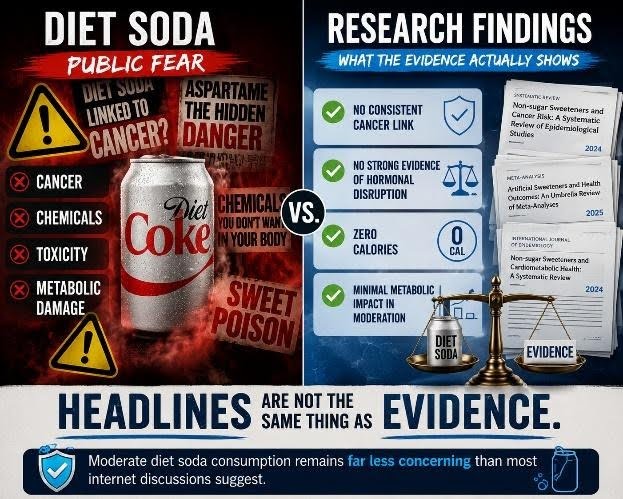
Aspartame gets discussed online like it’s industrial coolant mixed with pesticide and regret. But once you step away from social media panic and actually look at the literature? The picture changes dramatically.
What the Research Actually Says About Diet Soda
The biggest concerns around artificial sweeteners generally center around:
- cancer risk
- metabolic disruption
- insulin response
- gut microbiome changes
Those are legitimate things to study. But studying a possibility and proving harm are not the same thing.
A 2024 systematic review examining 90 epidemiological studies across multiple sweetener categories and 17 cancer types found: No consistent association between artificial sweeteners and cancer.
A 2025 umbrella meta-analysis reviewing ten separate meta-analyses reached essentially the same conclusion. That doesn’t mean the science is “settled forever.” Science rarely works that way. It means the current weight of evidence does not support the hysteria.
Are There Still Open Questions?
Absolutely. There are still reasonable discussions around:
- gut microbiome effects
- appetite regulation
- insulin signaling
- long-term behavioral effects
And if someone personally feels better avoiding artificial sweeteners? Great. No issue, but we need to separate preference from proven physiological harm.
Those are not the same thing.
“The internet and network news often confuses possibility with proof.”
Now Let’s Talk About Alcohol
Because this is where the conversation suddenly becomes awkward. Alcohol gets treated very differently socially.
People rarely say: “You still drink wine? Aren’t you worried about your health?”
…with the same intensity they attack artificial sweeteners.
But from the perspective of:
- body composition
- hormones
- recovery
- sleep
- fat loss
…the evidence around alcohol is dramatically more concerning.
Alcohol Quietly Destroys Deficits
This is the first major issue.
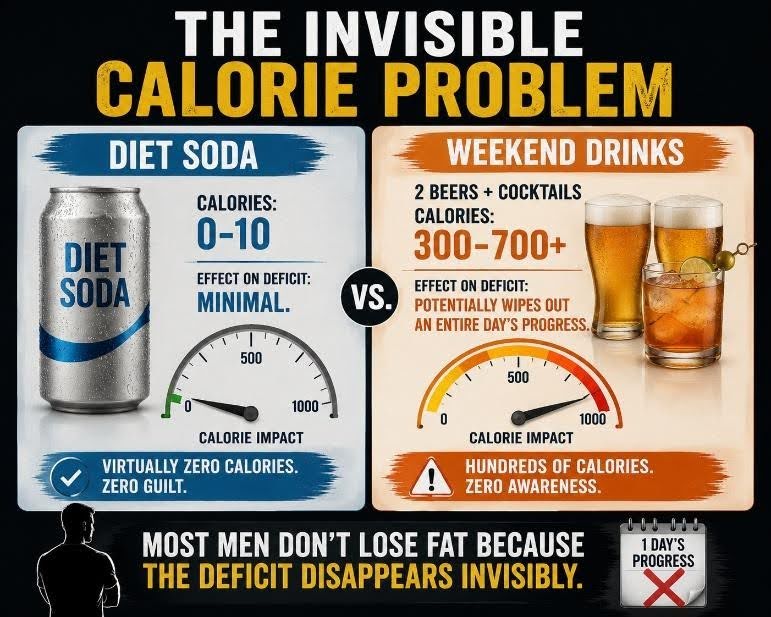
Alcohol contains: 7 calories per gram.
Almost as calorie-dense as fat.
But unlike protein or carbohydrates:
- it doesn’t support recovery
- it doesn’t support muscle
- it doesn’t meaningfully increase satiety
A couple drinks can quietly erase a caloric deficit extremely fast.
Especially when alcohol lowers food restraint afterward. For men trying to lose body fat after 40? This is often the hidden variable sabotaging progress.
Alcohol and Testosterone
This part matters even more for middle-aged men. Testosterone already declines gradually with age. The hormonal environment after 40 is not the same as it was at 25. Research consistently shows that heavier alcohol intake suppresses testosterone production.
One controlled study demonstrated approximately:
20–23% testosterone suppression following heavy alcohol intake.
Now to be fair, that does NOT mean: “One drink destroys your hormones.”
Context matters. Moderate occasional drinking is not the same thing as regular heavier intake. But pretending alcohol is physiologically neutral for hormones also isn’t accurate.
Alcohol and Muscle Recovery
This is another area most men underestimate.
Post-workout alcohol consumption has been shown to reduce muscle protein synthesis significantly.
Meaning: if you trained hard Friday night and drank heavily afterward? You partially blunted the adaptation you just worked for. That’s not internet bro-science. That’s documented physiology.
“You can train hard and still quietly undermine recovery afterward.”
The Sleep Problem Is Bigger Than Most Men Realize
A lot of people think alcohol helps sleep because it helps them fall asleep faster. But quality sleep and unconsciousness are not identical.
Alcohol disrupts:
- REM sleep
- slow-wave sleep
- recovery quality
- overnight hormonal regulation
Which often leads to:
- elevated cortisol
- worse recovery
- increased hunger the next day
- lower training performance
- worse decision-making
This is one reason men often feel flatter, puffier, softer, and less recovered after consistent drinking periods. Even if calories remain similar.
So Is Diet Soda “Healthy”?
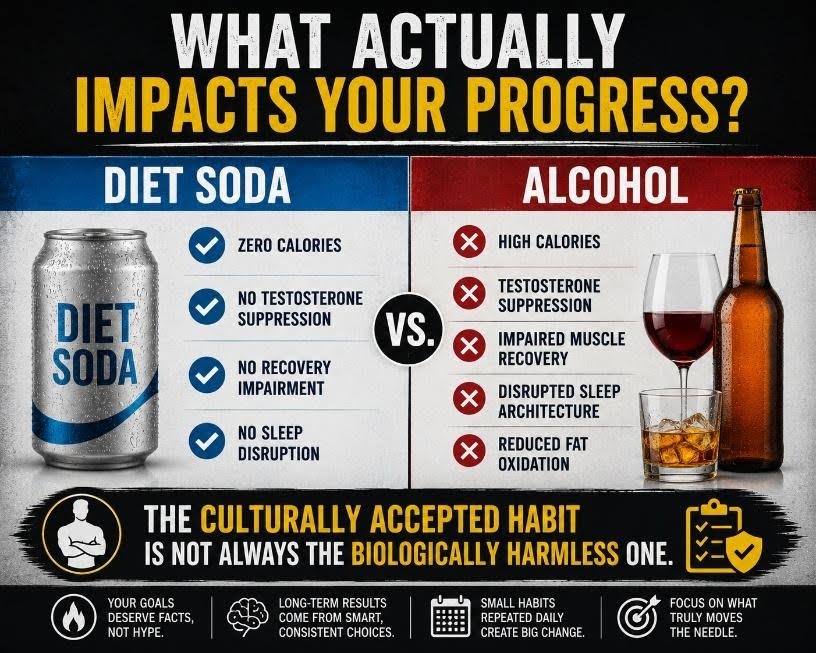
That depends how you define healthy. Water is obviously the superior choice overall. Nobody’s arguing otherwise. But the internet often frames diet soda like it’s worse than actual physiologically damaging habits. And based on current evidence? That simply doesn’t hold up.
Especially when compared directly against:
- regular heavier drinking
- excess calories from alcohol
- impaired recovery
- hormonal suppression
- sleep disruption
This Isn’t an Anti-Alcohol Sermon
That’s important. I’m not trying to turn this into: “Alcohol is evil.” Many people drink moderately and maintain excellent health.
I personally stopped drinking entirely and it was one of the best decisions I ever made for:
- recovery
- body composition
- clarity
- discipline
- consistency
But that’s my experience.
The point is proportionality. If someone wants to enjoy a few drinks intentionally? Fine. Just understand the tradeoffs honestly.
“Know what you’re choosing and what it costs.”
Final Thoughts
If your goal is optimizing:
- body composition
- hormones
- recovery
- sleep
- energy
…then alcohol deserves far more scrutiny than diet soda.
Not because drinking occasionally makes someone unhealthy. But because the physiological effects are real, measurable, and often underestimated.
Meanwhile the fear around moderate diet soda intake is often driven far more by cultural panic than by the actual weight of evidence. And honestly? Middle-aged men already have enough real biological challenges to manage without inventing imaginary ones.
Research & Clinical References
Not social media panic. Actual research.
- Systematic review — Artificial sweeteners and cancer associations
https://pubmed.ncbi.nlm.nih.gov - Umbrella meta-analysis — Non-sugar sweeteners and health outcomes
https://pubmed.ncbi.nlm.nih.gov - National Institutes of Health — Alcohol and testosterone suppression
https://www.ncbi.nlm.nih.gov - PLOS ONE — Alcohol ingestion and muscle protein synthesis after exercise
https://journals.plos.org/plosone - Sleep Foundation — Alcohol and sleep architecture disruption
https://www.sleepfoundation.org

About Norm Rieger
Norm Rieger is a men’s lifestyle coach, speaker, entrepreneur, and author of The New Norm — a project focused on helping men over 40 rebuild their health, physique, discipline, and mindset.
After transforming his own life later in adulthood, Norm now works with men looking for practical, honest guidance around fitness, body composition, nutrition, habits, recovery, and long-term health optimization.