
“The belly fat isn’t just sitting there. It’s participating.”
The Midsection Problem Almost Every Man Understands
You’re training. You’re trying to eat better. You’re doing “pretty good.” And yet the stomach barely moves. Sound familiar?
This post is for men in their 40s, 50s, and 60s who feel like their body stopped responding the way it used to. Because honestly? It did. And pretending otherwise helps nobody.
Belly Fat After 50 Is Biologically Different
This is the first thing most men need to understand. The belly fat men carry later in life is not simply:
- poor discipline
- laziness
- aging
- lack of cardio
It’s a hormonal and metabolic problem.
Specifically: visceral fat. The deeper abdominal fat surrounding the organs. And unlike the softer fat you carried in your 20s or 30s? Visceral fat is metabolically active.
Meaning: It actively influences hormones, inflammation, insulin sensitivity, and metabolism. It participates in the problem.
The Testosterone Loop Most Men Never Hear About
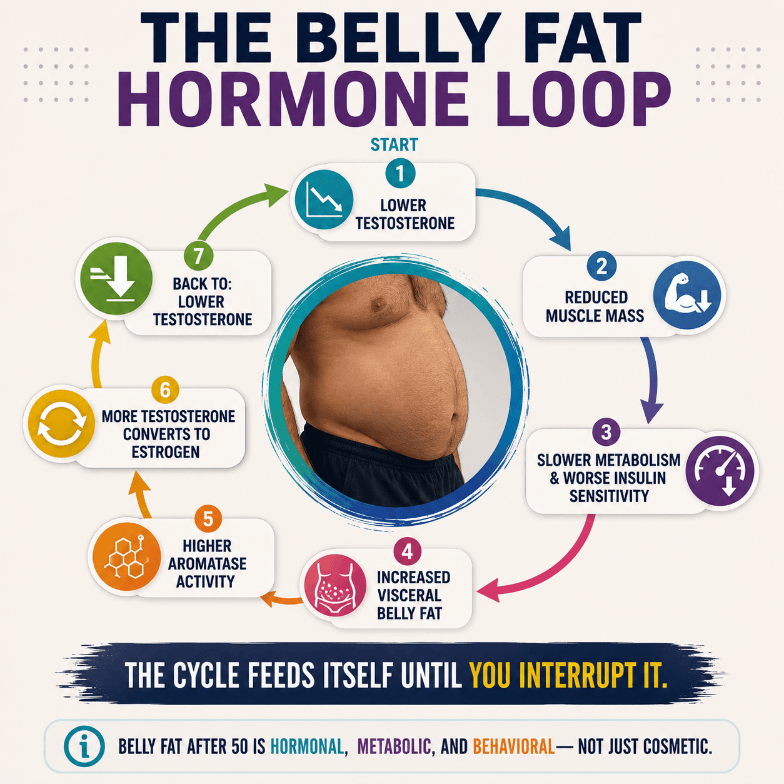
Testosterone production gradually declines beginning roughly around the mid-30s. Research estimates average declines of approximately 1–2% annually in many men. By the time men reach their 50s, they may have lost a meaningful percentage of peak production.
That matters because testosterone strongly influences:
- muscle retention
- insulin sensitivity
- energy expenditure
- recovery
- fat storage patterns
Lower testosterone often contributes to: Increased abdominal fat storage.
But then the cycle gets worse. Because visceral fat contains: Aromatase
An enzyme that converts testosterone into estrogen.
Meaning:
More belly fat → lower testosterone → more belly fat.
The cycle feeds itself.
Why Most Men Attack the Problem Backwards
This is the sequencing mistake almost every man makes. They decide to “get in shape” and immediately focus on:
- building muscle
- bulking
- eating more protein
- lifting heavier
…while still carrying a significant amount of body fat. And unfortunately? For most natural middle-aged men:
Trying to build significant muscle while aggressively losing fat usually fails.
At least simultaneously. Because your body needs:
- energy surplus to efficiently build tissue
- energy deficit to efficiently lose stored fat
Those are opposite biological signals.
“You can’t press the gas and brake hard at the same time and expect efficiency.”
The Statue Analogy
Here’s the simplest way I know how to explain this. Picture the body you want as a stone statue. Right now? The statue is wearing a jumpsuit. You can’t clearly see the shape underneath. Most men try to add muscle first.
So they start:
- eating more
- training harder
- chasing size
But all they’re really doing is stuffing more underneath the jumpsuit.
You can’t accurately tell:
- what’s muscle
- what’s fat
- whether the plan is truly working
The smarter sequence? Remove the jumpsuit first. Get lean enough to reveal the structure. Then when you begin building muscle, you can actually SEE the changes happening. That’s the sequence. Fat loss first. Then muscle.
The Weird Middle Phase Nobody Warns You About
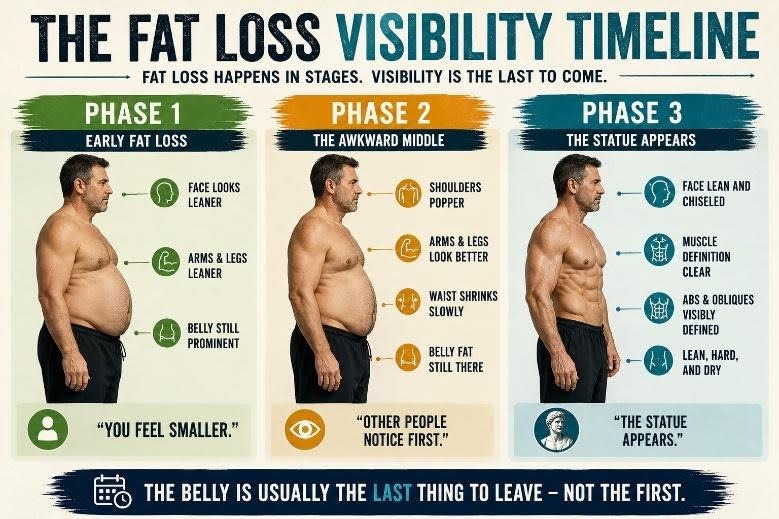
This part messes with people psychologically. When fat loss begins:
- your face leans out first
- your arms and legs lean out
Meanwhile:
The stomach hangs on like it’s protecting classified information.
That’s normal. Our bodies biology prioritizes abdominal fat storage aggressively. Especially visceral fat. There’s an awkward middle phase where men often think: “I’m just getting smaller.”
I experienced this personally. When I dieted down nearly 30 pounds in my mid-50s, I felt smaller. But suddenly other people started saying:
- “You look jacked.”
- “You look huge.”
- “What are you doing?”
Even though I weighed dramatically less. Because:
Lean changes everything.
The muscle was already there. It just became visible.
So What Actually Works?
No amount of:
- crunches
- ab circuits
- fat burners
- spot reduction gimmicks
…will specifically burn belly fat.
That concept has been disproven repeatedly in exercise physiology research. What DOES work is creating conditions where your body has no choice but to pull from stored fat over time.
That comes down to three things.
1. A Real Caloric Deficit
Not “eating clean.” Not “trying hard.” Not “mostly healthy.” A measurable deficit.
Fat loss always requires:
Calories out > calories in.
That’s the mechanism.
A sustainable deficit of roughly 300–500 calories daily is usually enough to steadily lose fat while preserving muscle. Most men dramatically underestimate intake. Especially:
- oils
- nuts
- restaurant meals
- alcohol
- weekend eating
Track honestly for a few weeks. Most people are shocked by what they discover!
2. High Protein Intake
When calories drop, your body can pull energy from:
- fat
- muscle
Protein helps preserve lean tissue.
For most active men over 50: roughly 0.75–1 gram per pound of target body weight is a highly effective range during fat loss.
Without adequate protein? The body often sacrifices muscle alongside fat.
And that usually worsens:
- metabolism
- appearance
- rebound potential
3. Resistance Training
This is the part most people still underestimate. Resistance training does far more than “burn calories.” It helps:
- preserve muscle
- improve insulin sensitivity
- support testosterone levels
- increase metabolic rate
- improve body composition
And importantly, it changes the hormonal environment. That’s why endless cardio alone usually disappoints middle-aged men.
You cannot outrun:
- poor nutrition
- hormonal dysfunction
- muscle loss
The training that changes middle-aged physiques most dramatically is progressive resistance training. Not living on a treadmill.
“The goal isn’t becoming lighter. The goal is becoming leaner.”
Final Thoughts
At 54, I looked better than I did at 34. Not because of perfect genetics or shortcuts.
Because I finally understood:
- the sequence
- the deficit
- the hormonal reality
- protein intake
- resistance training
- consistency
The belly fat that feels permanent usually isn’t permanent. But it does require:
Understanding the mechanism.
And doing the work in the right order. That order starts with fat loss. Then the muscle becomes visible. Then the entire body changes.
Research & Clinical References
Not gimmicks. Actual physiology and endocrinology.
- National Institutes of Health — Visceral fat and metabolic dysfunction
https://www.ncbi.nlm.nih.gov - Journal of Clinical Endocrinology & Metabolism — Testosterone decline and aging men
https://academic.oup.com/jcem - Frontiers in Endocrinology — Aromatase activity and obesity in men
https://www.frontiersin.org - American College of Sports Medicine — Resistance training and body composition
https://www.acsm.org - Obesity Reviews — Visceral fat reduction and metabolic health outcomes
https://onlinelibrary.wiley.com/journal/1467789x
About Norm Rieger
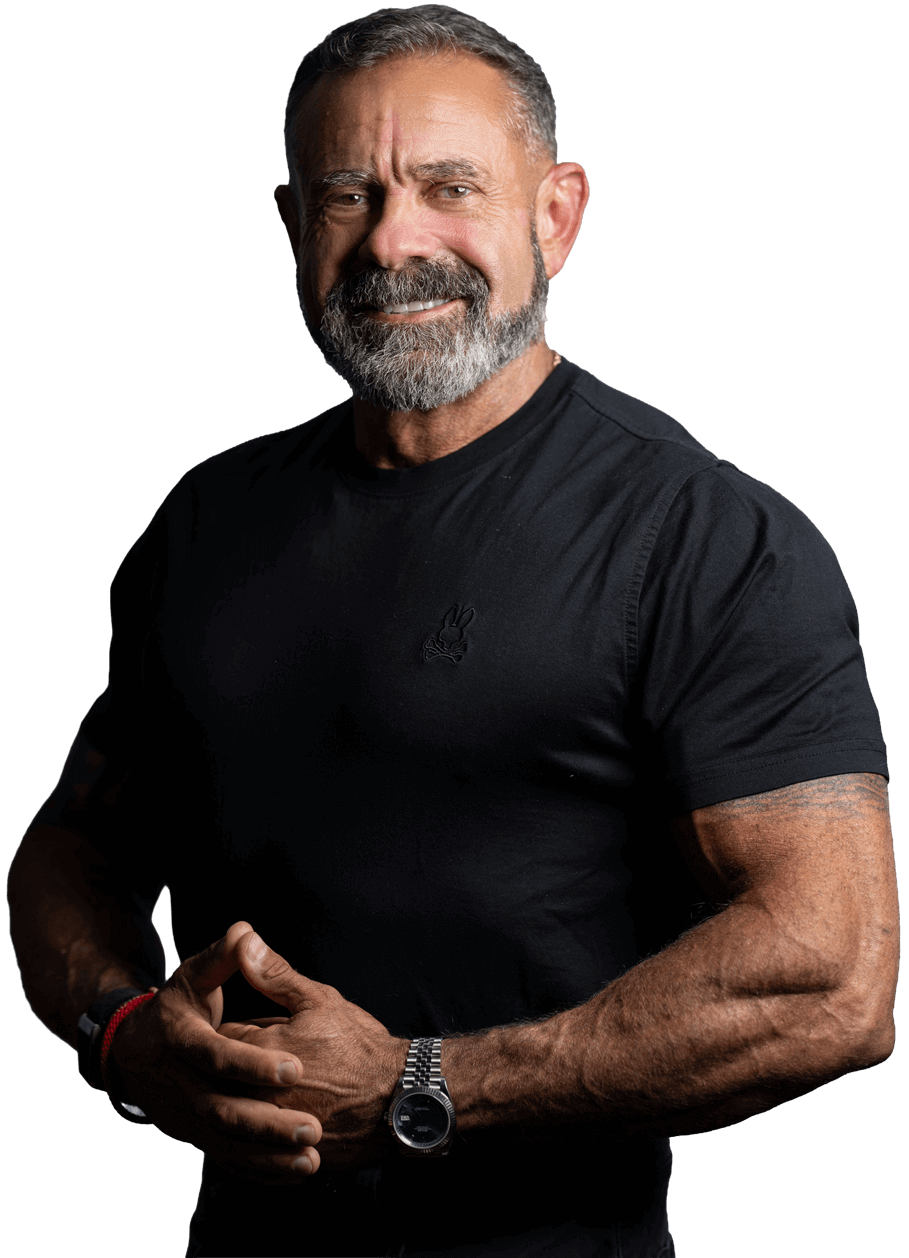
Norm Rieger is a men’s lifestyle coach, speaker, entrepreneur, and author of The New Norm — a project focused on helping men over 40 rebuild their health, physique, discipline, and mindset.
After transforming his own life later in adulthood, Norm now works with men looking for practical, honest guidance around fitness, body composition, nutrition, habits, recovery, and long-term health optimization.