
“Most men over 50 aren’t eating too much protein. They’re eating too little — and timing it badly.”
Protein Has Become Fitness White Noise
Shakes. Scoops. Influencers. Gym bros arguing over decimal points.
At this point, most men over 50 are either:
- exhausted by the conversation
- confused by conflicting advice
- under-eating protein entirely
- or chasing targets designed for 24-year-old bodybuilders living on chicken and rice
The irony?
Despite all the noise, most men in their 40s, 50s, and 60s still do not understand the few things about protein that actually matter.
And unfortunately, those details matter more as you age.
The Government Protein Recommendation Is a Survival Number
Let’s start with the number everyone quotes.
The current Recommended Dietary Allowance (RDA) for protein is:
Roughly 0.35 grams per pound of body weight per day
For a 180-pound man? That’s roughly 65 grams of protein daily. Now here’s the important part. That number was never designed to optimize:
- muscle retention
- body composition
- recovery
- performance
- healthy aging
- resistance training outcomes
It was designed to prevent deficiency.
That’s a completely different objective.
The Problem Men Over 50 Face: Anabolic Resistance
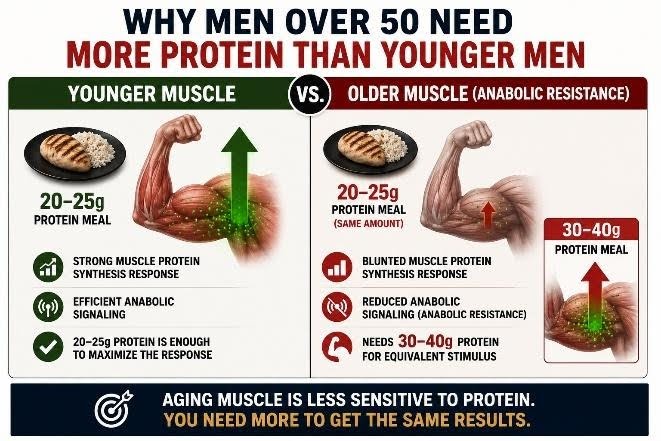
This is the physiological reality almost nobody explains properly. As men age, muscle tissue becomes less responsive to protein.
Researchers call this: Anabolic Resistance
In younger men: 20–25 grams of protein may strongly stimulate muscle protein synthesis. In older men? That same amount often produces a weaker response.
Meaning, men over 50 frequently require:
- more protein per meal
- higher total daily intake
- better protein distribution
…to achieve the same anabolic effect younger men get automatically.
This is one of the most important concepts in aging nutrition. And most men have never heard the term.
“Older muscle needs a louder signal.”
Protein needs increase with age — not decrease.
The Research Is Actually Pretty Clear
A 2014 review published in Frontiers in Nutrition concluded that the current RDA is insufficient for optimizing health and protecting older adults against sarcopenia.
A 2022 systematic review and meta-analysis published in the International Journal of Environmental Research and Public Health found that older adults with sarcopenia consistently consumed less protein than peers without it.
The evidence repeatedly points in the same direction:
Older adults need more protein than the minimum government recommendation.
Not less.
So How Much Protein Do Men Over 50 Actually Need?
That depends entirely on the goal. Not every man needs bodybuilding-level intake.
But almost every active man over 50 needs more than he thinks.
Goal #1: Fat Loss While Preserving Muscle
This is where protein becomes extremely important. Because during a caloric deficit, your body can pull energy from fat tissue and muscle tissue.
Adequate protein helps preserve lean mass while dieting.
Research consistently supports:
Roughly 0.75–0.85 grams per pound of body weight daily
…for active individuals trying to lose fat while retaining muscle.
For a 180-pound man? That’s approximately:
130–155 grams daily
In practical coaching terms? I often simplify it to: “Aim for roughly one gram per pound of target body weight during a cut.”
Not because it’s mathematically perfect.
Because it’s practical. Reliable. Easy to remember. And safely above the evidence-based floor.
Goal #2: Maintenance and Healthy Aging
If the goal is simply:
- staying strong
- maintaining muscle
- aging well
- preserving metabolic health
…the research still supports intake above the RDA.
Most evidence points toward:
Roughly 0.45–0.6 grams per pound daily
…combined with resistance training.
That places most active men over 50 somewhere around:
85–110 grams daily
…depending on body size and activity level.
This is where many men unintentionally under-eat.
Especially when appetite decreases with age.
Goal #3: Building Muscle After 50
This is where the internet gets especially noisy.
The research-supported range for muscle growth generally lands around:
Roughly 0.75–1+ gram per pound daily
Most evidence suggests diminishing returns beyond that range.
Meaning:
The protein industry’s obsession with endlessly increasing intake often has more to do with selling tubs than improving outcomes.
That doesn’t mean higher protein is dangerous.
It means:
More is not automatically better.
Especially if total calories, training quality, sleep, and recovery are poor.
“Protein supports muscle growth. It does not replace progressive overload.”
The Biggest Mistake Most Men Make
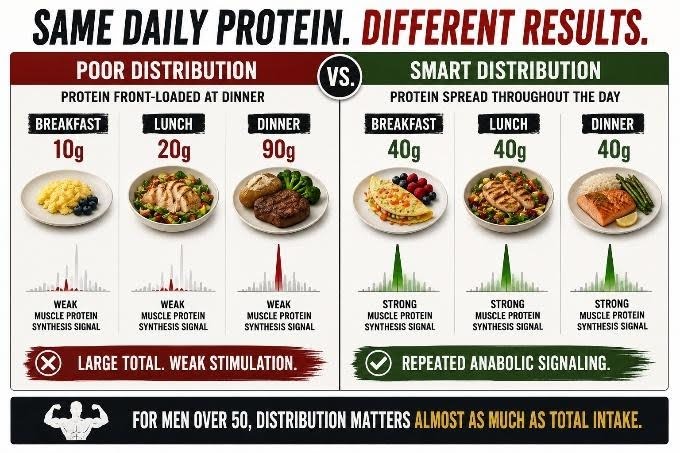
Even men hitting decent daily totals often distribute protein terribly. This matters. Because anabolic resistance is affected by:
- total daily intake
- per-meal intake
- meal timing
A man eating:
- 10g at breakfast
- 20g at lunch
- 90g at dinner
…is not stimulating muscle protein synthesis as effectively as someone eating:
- 35–45g across 3–4 meals
The per-meal threshold matters. Especially over 50.
Why Animal Protein Usually Wins
The research consistently favors complete protein sources for muscle protein synthesis.
That means:
- meat
- eggs
- fish
- poultry
- dairy
These contain all essential amino acids, including: Leucine. Leucine is one of the primary triggers for activating muscle protein synthesis.
Plant proteins can absolutely work. But they often require:
- higher total intake
- better food combining
- more intentional planning
…to reach equivalent anabolic stimulation.
That’s not ideology. That’s amino acid composition.
“And there’s nothing wrong with protein shakes or powders. For most of us, we need these to help us reach our protein goals. As long as the majority of your protein comes from whole foods with essential aminos acids, these products help get us there!”
The Kidney Myth Needs to Die
This comes up every single time protein gets discussed. “Too much protein damages your kidneys.” For healthy individuals with normal kidney function? The evidence does not support this fear.
Multiple reviews have found no evidence that protein intakes up to roughly 1 gram per pound of body weight per day damage kidney function in healthy adults.
Now if someone already has:
- kidney disease
- impaired renal function
- significant medical complications
…that becomes an individual medical conversation. But healthy active adults should stop being terrified of chicken breast.
The Practical Takeaway
Here’s the simplest version.
Fat loss with muscle retention? Roughly 0.75–0.85 grams per pound daily
Maintenance and healthy aging? Roughly 0.45–0.6 grams per pound daily
Active muscle building? Roughly 0.75–1+ gram per pound daily
Then:
- distribute protein across 3–4 meals
- prioritize whole food protein
- resistance train consistently
- stop obsessing over perfection
Because consistency beats optimization theater. Every time.
“Most men over 50 are under-muscled long before they’re over-proteined.”
Final Thoughts
Protein is not magic. But it is one of the few things in nutrition where the evidence is remarkably consistent.
As men age:
- muscle becomes harder to maintain
- anabolic signaling weakens
- recovery changes
- inactivity becomes more expensive metabolically
Protein helps offset that reality. Not by itself. But as part of the full system.
And once men finally understand that protein is not just a bodybuilding conversation — but an aging conversation — the entire topic starts making a lot more sense.
Research & Clinical References
Not supplement marketing. Actual literature.
- Frontiers in Nutrition — Protein requirements and aging muscle
https://www.frontiersin.org - International Journal of Environmental Research and Public Health — Protein intake and sarcopenia risk in older adults
https://www.mdpi.com/journal/ijerph - Nutrition & Metabolism — Aging muscle and anabolic resistance research
https://nutritionandmetabolism.biomedcentral.com - American Journal of Clinical Nutrition — Per-meal protein thresholds in older adults
https://academic.oup.com/ajcn - British Journal of Sports Medicine — Morton et al. protein meta-analysis
https://bjsm.bmj.com - ESPEN Guidelines — Protein intake recommendations for older adults https://www.espen.org

About Norm Rieger
Norm Rieger is a men’s lifestyle coach, speaker, entrepreneur, and author of The New Norm — a project focused on helping men over 40 rebuild their health, physique, discipline, and mindset.
After transforming his own life later in adulthood, Norm now works with men looking for practical, honest guidance around fitness, body composition, nutrition, habits, recovery, and long-term health optimization.