
“TRT amplifies your lifestyle. It doesn’t replace it.”
Most Men Don’t Need More Motivation.They Need Better Information.
This post is for men in their 40s, 50s, and 60s who are:
- curious about TRT
- overwhelmed by the noise online
- already on testosterone and wondering why they still don’t feel transformed
- scared off by the stigma
I’ve been on TRT for roughly fifteen years. I won a physique contest at 54. And my life didn’t meaningfully change until about seven years after I started. That part matters.
Because most of the conversation around testosterone replacement therapy lives at two ridiculous extremes:
“TRT is dangerous.” or: “TRT changes everything.”
Neither is true. And honestly? Both narratives usually come from people who don’t fully understand what testosterone actually does.
“Normal” Doesn’t Always Mean Optimal
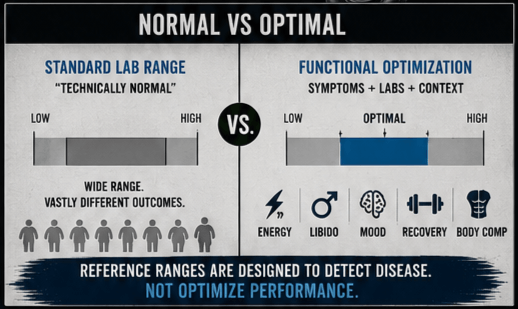
I was in my early 40s when a friend suggested I get my testosterone checked. Why? I just felt… off. And every attempt to “get back into shape” felt like pushing a car uphill.
I assumed: “This is just aging.”
My regular doctor ran labs every year. Everything came back: “Normal.” That word does a tremendous amount of work in modern medicine. And very little of it helps a man trying to function at a high level.
So eventually I went to a physician who specialized in men’s hormonal health. For the first time, someone explained my labs: In context. Not just against a giant statistical reference range. My levels weren’t catastrophic. But they were low enough to matter. And this was nearly fifteen years ago – before TRT became mainstream internet content.
Back then, most people only associated testosterone with:
- steroid scandals
- professional sports
- bodybuilders
So my reaction wasn’t excitement. It was confusion.
The Needle Fear
Then came the treatment conversation.
Creams. Injections. Needles.
I had never injected myself with anything in my life. And when I saw the giant harpoon needles some clinics still hand out in starter kits? I almost walked out. I’m assuming that I’m not the only one who had that moment.
So let me save some men unnecessary anxiety: The default TRT setup is NOT your only option.
There are:
- smaller gauge needles
- different injection frequencies
- alternative injection sites dramatically easier approaches
- subcutaneous protocols
If fear of injections is stopping you from exploring TRT, talk to your provider before assuming the entire process isn’t for you. Because some clinics are still operating like it’s 1998.
TRT Didn’t Change My Life
And this is where my story diverges sharply from internet TRT marketing. For the next seven years: My body did not dramatically transform.
Some things improved.
- energy improved
- recovery improved
- overall wellbeing improved
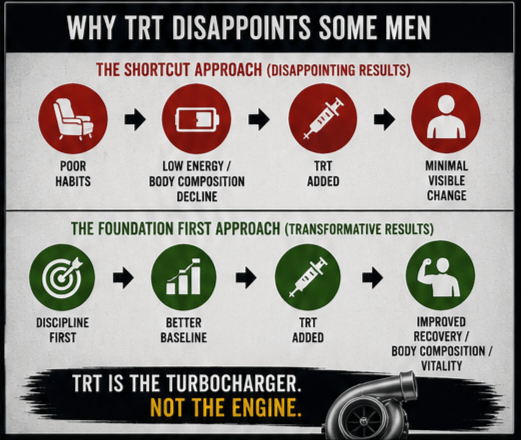
But I did NOT suddenly become the version of myself I imagined. Why? Because I was still:
- drinking regularly
- inconsistent in the gym
- undereducated about nutrition
- not prioritizing sleep
- not building disciplined routines
- not training with structure or intent
I optimized one variable. While neglecting the rest of the system. And this is the part most clinics and influencers do not explain clearly enough.
TRT DOES NOT REPLACE DISCIPLINE
This is the part the ads conveniently leave out.
Testosterone replacement therapy does NOT:
- change your habits
- change your discipline
- change your nutrition
- change your consistency
- change your behavior
And unless you’re already training intelligently and living reasonably well? TRT alone may not dramatically change your physique either. In some cases, it can even complicate hormonal management.
Men carrying higher amounts of visceral fat often have increased aromatase activity – meaning more testosterone converts into estradiol. That’s not a good thing. Research consistently links obesity with altered hormonal signaling and increased aromatase expression in men.
Translation? If your:
- sleep is terrible
- body fat is high
- nutrition is poor
- alcohol intake is excessive
…TRT alone may not fix much. That’s not a failure of testosterone. That’s misunderstanding what testosterone actually is.
“TRT is the amplifier. Not the foundation.”
My Hormones Changed Earlier. My Life Changed When My Habits Did.
Everything finally changed roughly seven years after I started TRT. That’s when I finally aligned:
- the morning routine
- journaling
- removing alcohol
- understanding calories and macros
- consistent resistance training
- sleep
- structure
- intentional habits
And once all of THAT aligned? The testosterone finally had something to work with. It was like having a high-performance engine sitting in a car with four flat tires. The engine had been there the whole time. The rest of the vehicle finally got fixed.
The Stigma Problem
Why the TRT Conversation Gets Distorted
This is where a lot of men either:
- avoid legitimate help
- misunderstand hormone therapy entirely
- dismiss the results of men who genuinely needed optimization
The most common reaction I hear is: “Well obviously you look like that. You’re on steroids.” And honestly? Fifteen years ago, I probably would’ve said the same thing. Because most people do not understand the difference between:
- hormone replacement therapy
- supraphysiological anabolic steroid use
Those are NOT the same thing. Not remotely.
The Cholesterol Analogy
This is the analogy that cuts through the noise best.
My natural LDL cholesterol sits around 105 without medication. My doctor prescribes something to optimize it. Nobody says: “That’s cheating.” Nobody says: “You should just accept your genetics.”
But somehow testosterone gets treated differently.
If one man naturally peaks at: 900 ng/dL…and another naturally peaks at: 400 ng/dL…why is only one considered “natural” while the other is reckless for trying to optimize?
Neither man chose his baseline.
The inconsistency around hormonal optimization compared to every other form of medical optimization is one of the stranger double standards in modern men’s health.
Testosterone Is About More Than Muscle
Longevity, Metabolic Health, and Quality of Life
Low testosterone is associated in research with:
- metabolic syndrome
- type 2 diabetes
- cardiovascular risk
- reduced quality of life
- increased mortality risk
Research examining testosterone quintiles repeatedly shows that men with healthier endogenous testosterone levels often demonstrate:
- lower rates of comorbidities
- better metabolic outcomes
- improved vitality markers
Healthy testosterone levels are tied to:
- energy
- cognition
- recovery
- lean mass retention
- bone density
- metabolic health
- overall vitality
The physique improvements are almost secondary.
Let’s Be Honest About Vanity
Most men initially explore TRT because they want to:
- look better
- feel younger
- regain confidence
- stop feeling invisible
- lean out
- perform better
And honestly? I don’t think that’s a problem. Because if vanity gets a man into:
- the gym
- healthier eating
- better sleep
- more discipline
- reduced alcohol intake
…the physiological benefits are still real.
The body doesn’t grade your motives. It responds to your actions.
“The body doesn’t grade your motives. It responds to your actions.”
Choosing a TRT Provider Carefully
If you’re considering TRT, here’s my honest advice.
Be your own advocate.
Read actual research. Be skeptical of:
- social media certainty
- influencer protocols
- miracle claims
Look for:
- physicians who specialize in this. And your PC might not be the ideal provider.
- endocrinologists
- evidence-based providers
Not internet personalities trying to sell identities.
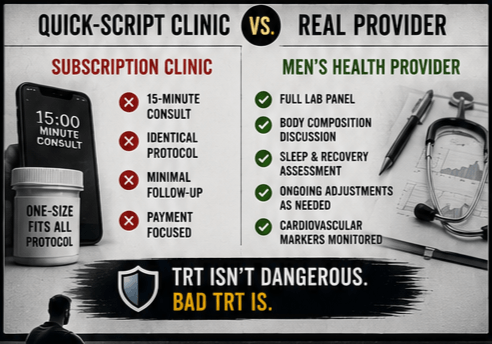
Choose your provider carefully.
Some clinics genuinely care about:
- long-term outcomes
- cardiovascular health
- hormonal balance
- body composition
- blood work trends
Others are essentially:
Subscription businesses.
That’s reality.
Ask questions.
The standard protocol is NOT the only protocol.
The goal isn’t:
“Getting a prescription.”
The goal is finding an approach that genuinely improves:
- health
- function
- quality of life
- long-term outcomes
That’s the actual objective.
What Really Matters
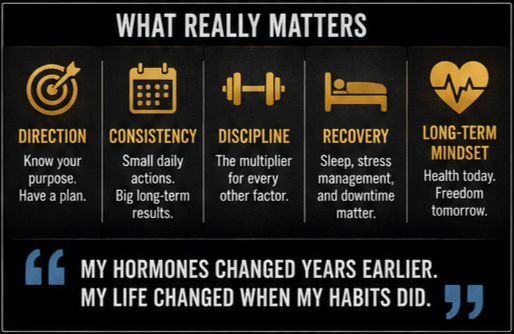
At the end of all this? The biggest transformations I’ve seen in myself and other men came from combining:
- discipline
- training
- nutrition
- recovery
- consistency
- hormonal optimization when appropriate
Not from hormones alone.
Final Thoughts
If you don’t want to spend hundreds of hours researching:
- hormones
- blood work
- nutrition
- recovery
- body composition
…find someone you trust who has actually lived through the process honestly.
Because testosterone replacement therapy is neither: Magic. Nor: Evil.
It’s one variable. And your results will always depend on the rest of the equation.
Research & Clinical References
Not influencer clips. Actual medical and clinical resources.
- Mayo Clinic — Testosterone therapy: Potential benefits and risks for aging men
https://www.mayoclinic.org/healthy-lifestyle/sexual-health/in-depth/testosterone-therapy/art-20045728 - Cleveland Clinic — Low Testosterone (Low T): Causes, Symptoms & Treatment
https://my.clevelandclinic.org/health/diseases/15285-low-testosterone - National Institutes of Health — Obesity in men: the hypogonadal-estrogen receptor relationship and its effect on glucose homeostasis
https://pmc.ncbi.nlm.nih.gov/articles/PMC8603736/ - Journal of Clinical Endocrinology & Metabolism — Testosterone, obesity, and metabolic syndrome associations in aging men
https://academic.oup.com/jcem - American Urological Association — Testosterone Deficiency Guideline
https://www.auanet.org/guidelines-and-quality/guidelines/testosterone-deficiency-guideline
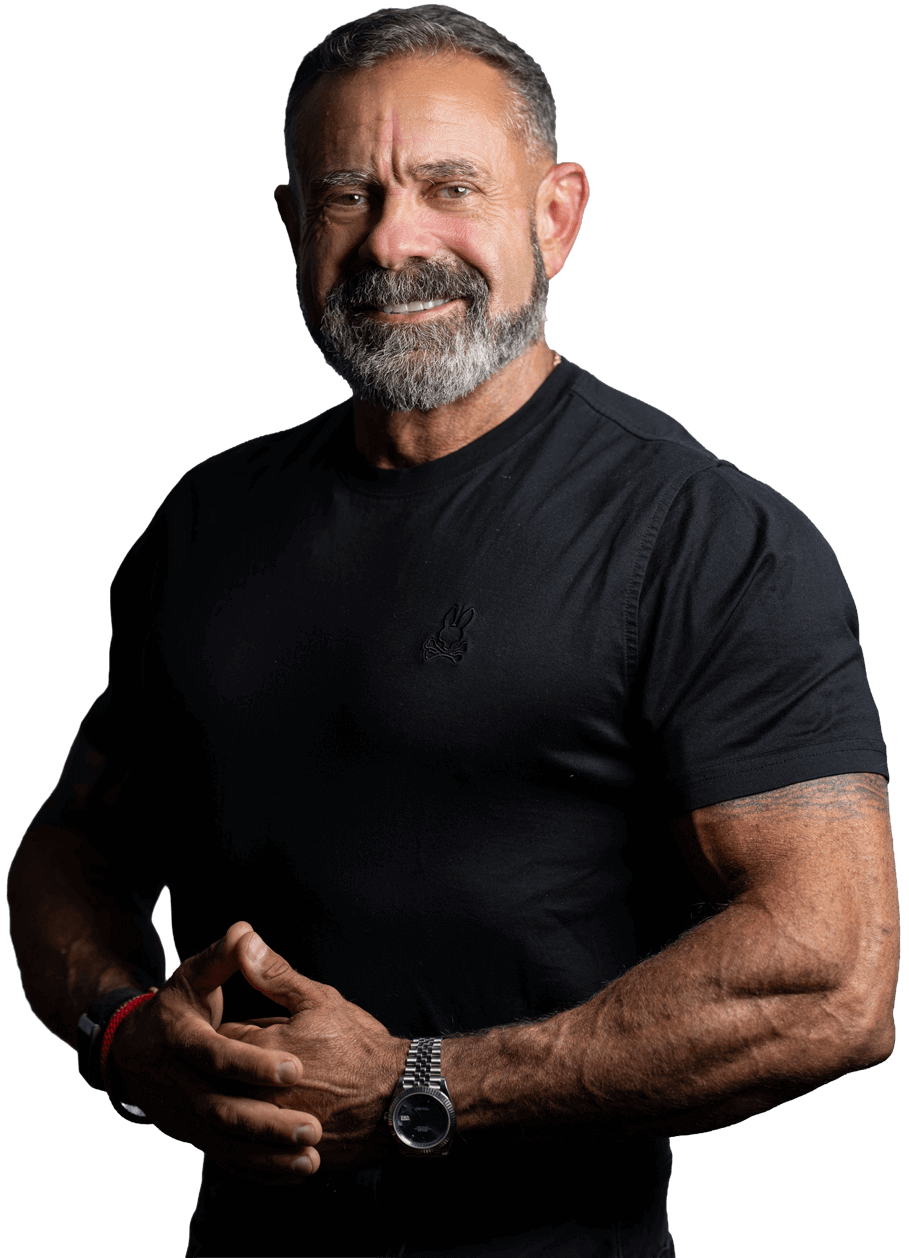
About Norm Rieger
Norm Rieger is a men’s lifestyle coach, speaker, entrepreneur, and author of The New Norm — a project focused on helping men over 40 rebuild their health, physique, discipline, and mindset.
After transforming his own life later in adulthood, Norm now works with men looking for practical, honest guidance around:
- body composition
- fitness
- recovery
- hormones
- nutrition
- long-term health optimization